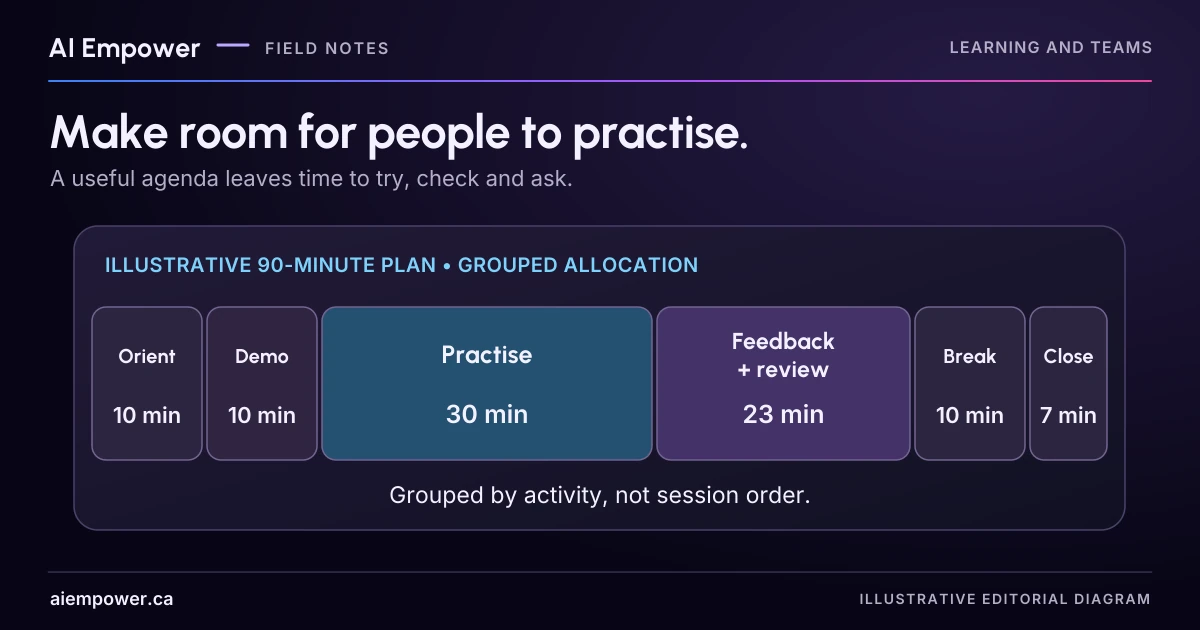
Allocate time for an observable task, a second attempt, feedback, breaks and access needs before adding demonstrations.
A ninety-minute workshop can contain five demonstrations and leave people with almost no time to try anything. Start with the task participants should practise, then reserve time for an attempt, feedback and a second attempt.
The agenda below is a fictional adult workshop about reviewing AI-assisted writing. Its timings are a planning example, not a tested AI Empower course or a guarantee that participants will master a tool.
Choose one observable output
The learning task is: “Compare a short draft with an approved fictional source, identify unsupported statements and produce a corrected version with reasons.”
That is specific enough to plan around. “Understand AI” is too broad to tell the facilitator what to teach, what to leave out or what participants should produce. Tool navigation, image generation and automation design would each need their own objectives and practice.
The CDC Quality Training Standards include learner engagement and opportunities for feedback. The example agenda applies that general training guidance to a narrow adult exercise; it does not imply CDC approval of the workshop.
Use a short fictional source
The source note says: “An adult repair-skills session covers replacing a button and repairing a small seam. Materials are supplied. The note does not specify the date, time, location or accessibility arrangements.”
A deliberately flawed draft says: “Join our free Saturday workshop at the community hall. All equipment is provided, and everyone will leave able to repair any garment.”
Participants can identify unsupported cost, date, venue, scope and outcome claims without sharing private information or needing a personal AI account. A possible corrected version is: “The adult repair-skills session covers replacing a button and repairing a small seam. Materials are supplied. Date, time, location and accessibility arrangements need confirmation.”
The exercise checks fidelity to the note. It does not establish that the fictional event is offered or that its arrangements are adequate.
Build a run of show that adds up
| Time | Activity | Participant output |
|---|---|---|
| 0–10 minutes | Welcome, access check and task explanation | Knows the source, task and participation choices |
| 10–20 | Facilitator models one claim check | One demonstrated source-to-claim comparison |
| 20–35 | First individual or paired attempt | Marked draft and reasons |
| 35–45 | Compare findings and give feedback | A correction to the review approach |
| 45–55 | Break | Time protected from extra teaching |
| 55–70 | Second attempt with a changed draft | Revised text and evidence notes |
| 70–83 | Review decisions and unresolved questions | Completed comparison record |
| 83–90 | Close and identify a next practice step | A bounded next task |
The blocks total ninety minutes. Practice occupies thirty minutes across two attempts, with feedback and review scheduled separately. Those quantities describe this plan only; they are not universal proportions for good training.
Make the second attempt different enough to matter
For the second round, provide a draft that preserves the date as unknown but changes “materials are supplied” to “bring your own materials.” Ask participants to check the whole meaning rather than search only for the invented details from round one.
This gives feedback somewhere to go. A participant who learned to check missing information must now also notice a contradiction. Keep the source and decision standard stable so the new attempt is comparable in purpose.
Allow a written, spoken or supported response appropriate to the group. A person should not have to speak quickly in front of everyone to demonstrate the review decision. The exercise’s output is a corrected draft with reasons, not a competition to identify the most errors first.
Protect the time people need
A plan can total ninety minutes and still be unrealistic if instructions, transitions or access arrangements consume time that was assigned to practice. Rehearse the activity with a colleague. Count opening materials, explaining the worksheet, moving between individual and paired work and gathering feedback.
W3C’s accessible-events guidance recommends planning for access needs, usable materials and breaks. Ask about the actual group’s requirements and prepare appropriate formats in advance. A printed handout alone does not meet every need.
If the demonstration runs long, use a preselected cut: remove a second example or an optional feature tour. Do not automatically take the minutes from the second practice attempt or the break. Name the cut in the facilitator’s run sheet before the session.
Test an overfull version
Add a proposed twenty-minute tour of another AI tool to the agenda. The total becomes 110 minutes. Decide what to remove or whether the objective and session length must change.
Do not solve the arithmetic by assuming everyone can work faster. If every block is essential, split the session or narrow its outcome. Keep any decision visible so the invitation and learning promise still match the delivered format.
Your finished agenda should include times, activity instructions, participant outputs, access arrangements, materials and an explicit cut list. After delivery, record where the timing differed and what participants actually had time to produce. Use those observations to revise the next session rather than claiming mastery from attendance.
READER WORKBENCH / WEEK 49
Protect the practice in the agenda
Build a fictional adult workshop with two attempts and feedback. The example reserves a break and shows a twenty-minute optional tour pushing the plan over budget. Arithmetic cannot establish access or mastery.
Fictional local exercise. No live AI, backend, business verification, analytics, accounts or paid services. Working state is kept in page memory; deliberate copies, prints and browser/device-managed data are outside this tool’s control. This is not a privacy guarantee, release approval, measured outcome or accessibility certification. Enter fictional, non-sensitive examples only.
Review pending · current working preview
Agenda arithmetic fits the stated length
- Planned total: 90 minutes. Session: 90 minutes. Practice attempts: 30 minutes.
- 0–10 min: Welcome, access check and task explanation → Participation choices and source task understood
- 10–20 min: Model one claim check → One source-to-claim comparison
- 20–35 min: First practice attempt → Marked fictional draft with reasons
- 35–45 min: Feedback → A corrected review approach
- 45–55 min: Protected break → Time free of teaching
- 55–70 min: Second practice attempt → Revised draft and evidence notes
- 70–83 min: Review decisions and unknowns → Completed comparison record
- 83–90 min: Close and next practice step → A bounded next task
- Unallocated margin: 0 minutes; this is not proof that transitions and access needs fit.
- Preselected cut/split: Remove the optional tour before touching the second attempt or break
- The agenda does not prove mastery, accessibility, actual event availability or real timing. Unknown date, location and access details remain unknown in the fictional source.
Unresolved warnings
- Unresolved: Fictional facilitator
- Unresolved: Timing rehearsal observation
- Timing and access review is pending.
Superseded evidence snapshots retained: 0. These are exported as historical records, never counted as current passes.
WEEK 49 — Protect the practice in the agenda
Fictional local exercise. No live AI, backend, business verification, analytics, accounts or paid services. Working state is kept in page memory; deliberate copies, prints and browser/device-managed data are outside this tool’s control. This is not a privacy guarantee, release approval, measured outcome or accessibility certification.
Review pending: the current input preview has not been reviewed
Agenda arithmetic fits the stated length
Planned total: 90 minutes. Session: 90 minutes. Practice attempts: 30 minutes.
0–10 min: Welcome, access check and task explanation → Participation choices and source task understood
10–20 min: Model one claim check → One source-to-claim comparison
20–35 min: First practice attempt → Marked fictional draft with reasons
35–45 min: Feedback → A corrected review approach
45–55 min: Protected break → Time free of teaching
55–70 min: Second practice attempt → Revised draft and evidence notes
70–83 min: Review decisions and unknowns → Completed comparison record
83–90 min: Close and next practice step → A bounded next task
Unallocated margin: 0 minutes; this is not proof that transitions and access needs fit.
Preselected cut/split: Remove the optional tour before touching the second attempt or break
The agenda does not prove mastery, accessibility, actual event availability or real timing. Unknown date, location and access details remain unknown in the fictional source.
UNRESOLVED WARNINGS
Unresolved: Fictional facilitator
Unresolved: Timing rehearsal observation
Timing and access review is pending.
EXACT CURRENT INPUTS
{
  "objective": "Correct a fictional draft against its approved source and explain the changes",
  "source": "Adult repair-skills session: replacing a button and repairing a small seam. Materials supplied. Date, time, location and access arrangements unspecified.",
  "firstDraft": "Free Saturday workshop at the community hall. Everyone will repair any garment.",
  "secondDraft": "Date unknown. Bring your own materials to practise replacing a button and repairing a small seam.",
  "access": "Offer written, spoken or supported participation; confirm formats with the actual adult group",
  "materials": "Fictional source and two drafts in usable formats. Rehearse opening materials and moving between activities.",
  "budget": "90",
  "minutes_welcome": "10",
  "minutes_model": "10",
  "minutes_first": "15",
  "minutes_feedback": "10",
  "minutes_break": "10",
  "minutes_second": "15",
  "minutes_review": "13",
  "minutes_close": "7",
  "tour": "no",
  "cut": "Remove the optional tour before touching the second attempt or break",
  "owner": "",
  "rehearsal": "",
  "checked": "no",
  "note": ""
}
HISTORICAL EVIDENCE SNAPSHOTS (not current; preserved failed and superseded attempts)
[]
External verification not performed: live sites, actual services, source refresh, production integration, real browser/mobile, screen readers, physical keyboard, actual clipboard permissions, printing/pagination.
Use the text-only exercise
The complete unchanged manuscript remains readable if the controls are unavailable.
Return to Test an overfull versionPrimary sources checked 4 October 2026
Sources & review
Primary sources checked on . The checklists and planning examples are AI-assisted editorial guidance, not source quotations or reported client results.
This AI-assisted guide uses fictional examples for practice. It does not report client results or establish that a live system will behave the same way.
Originally published: .