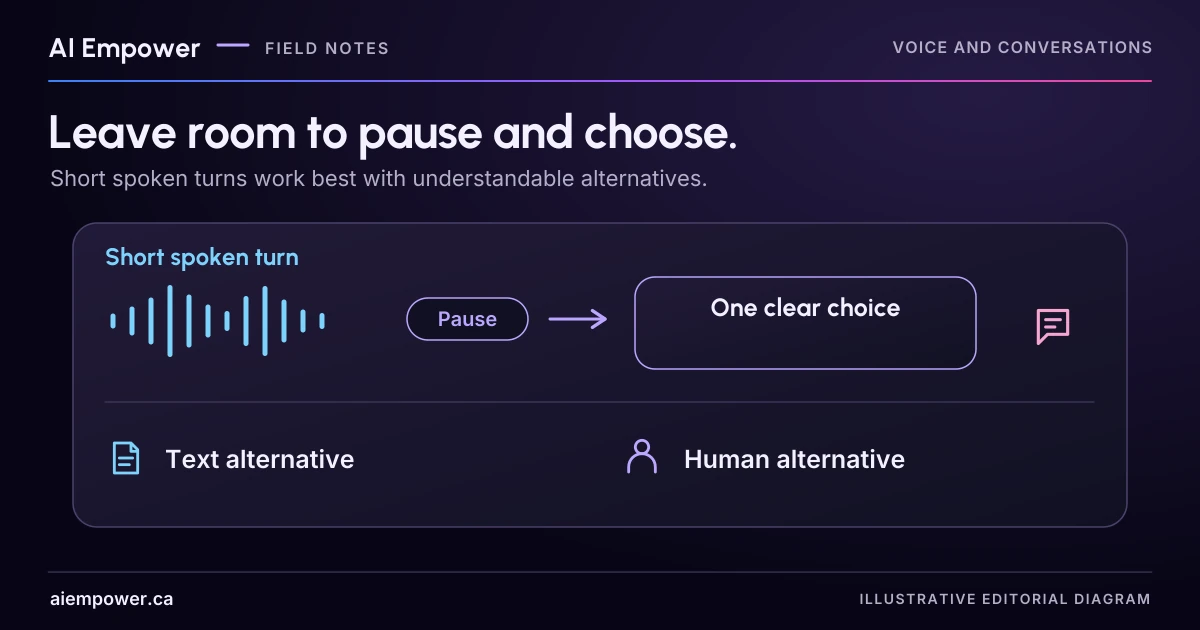
Rewrite the script around one decision at a time, rehearse repeat and channel choices, then test the actual audio experience separately.
Read this fictional response aloud:
“Our print-preparation service covers file checking, proof preparation and collection arrangements, and before we can advise you we need the format, intended use, file type, preferred date and whether you need help with the design, so please tell me those details.”
Where should the caller answer? Which question should they answer first? If they interrupt after “file checking,” will the conversation still make sense?
A spoken turn has a practical limit: the caller must understand enough of it to continue. You can improve the script before choosing a voice or tuning a platform. Then you need to hear and test the actual implementation, because a readable transcript does not demonstrate usable audio.
Rewrite one decision at a time
For the same fictional enquiry, try this opening:
Assistant: “I can explain file checks or how to request a print proof. What would you like to know?”
Caller: “I have a poster file. Can someone check it?”
Assistant: “The fictional service includes a file check before proof preparation. What type of file do you have?”
That version leaves a clear place to answer and limits the first question to a useful choice. It still needs the business’s approved facts before real use. Do not retain the word “includes” if the actual service or price does not support it.
Microsoft’s current voice-agent design guidance recommends short spoken turns, one question at a time and tests for pauses and interruptions. The examples here are provider-independent planning exercises, not a claim that every voice system implements those behaviours.
Mark what the caller can control
Copy the revised exchange and add a note after each assistant turn:
- Answer now: what response is the assistant waiting for?
- Repeat: which information would be repeated if requested?
- Pause: can the caller take time to find a detail without being rushed?
- Interrupt: what should stop when the caller begins speaking?
- Change route: how can the caller use text or ask for a person?
Do not write “interrupt anytime” unless the actual service supports and has tested that behaviour. For a prototype script, mark it as a requirement awaiting implementation verification.
In the poster example, “What type of file do you have?” should permit “I’m checking,” “Please repeat that” and “Can I do this by email?” A system that handles only a quick file-type answer has a narrow happy path. Record an honest alternative rather than repeatedly demanding the same response.
Run the three-person reading exercise
One colleague reads the assistant, one plays a caller and a third records observations. Use the fictional source only; nobody needs to reveal real account details or record their voice. Ask permission before any recording and use the organisation’s approved process if recording is necessary.
Run these four variations:
- The caller answers immediately with a short response.
- The caller pauses mid-sentence, then finishes the same thought.
- The caller asks to repeat the last question.
- The caller asks for a text route before the assistant finishes.
The reader can simulate the intended response, but label that as a script rehearsal. A person politely waiting for a pause does not prove that software will detect it. Record where the script itself caused confusion, separately from any behaviour you still need the platform to provide.
Use an observation sheet with the turn, caller’s apparent understanding, interruption point, information already heard, information still needed and proposed revision. Avoid grading the caller. Hesitation may reveal an unclear question or a missing choice.
Week 34 · interactive local candidate
Inspect the words heard before an interruption
Fictional local exercise. No AI backend, automatic input submission, analytics, application storage, actual approvals, messages or business changes. Static page assets may load normally. Reset or reload clears this exercise’s working state, not copies, printouts or browser/device-managed data. Use invented details only. A completed exercise is not release approval.
Review pending. Change inputs, then review the current version. Earlier results are cleared after every edit.
Week 34: Inspect the words heard before an interruption
Fictional local exercise. No AI backend, automatic input submission, analytics, application storage, actual approvals, messages or business changes. Static page assets may load normally. Reset or reload clears this exercise’s working state, not copies, printouts or browser/device-managed data. Use invented details only. A completed exercise is not release approval.
All observations and checks below are fictional or reader-reported; none independently verified.

FIXED FICTIONAL EXERCISE CONTEXT
{
  "presets": {
    "safe": [
      "Staff need to review the file before a proof can be arranged.",
      "What type of file do you have?"
    ],
    "late": [
      "Yes, we can arrange that,",
      "subject to staff reviewing the file.",
      "Tell me the format, intended use, file type, preferred date and design needs."
    ]
  },
  "boundary": "Text segment rehearsal only. Segment breaks are author-selected, not detected speech. No microphone, audio synthesis or playback. Actual pace, pronunciation, interruption detection and channel switching remain untested."
}

CURRENT INPUTS (fictional / reader-entered)
{
  "preset": "safe",
  "segments": [
    "Staff need to review the file before a proof can be arranged.",
    "What type of file do you have?"
  ],
  "heard": "1",
  "caller": "pause",
  "recovery": "condition",
  "observation": "",
  "revision": ""
}

Review pending. No current result; any earlier review was invalidated by input changes.

LIMITATIONS AND WARNINGS
• All states are fictional or reader-reported. This exercise does not validate a real source, approval, system or outcome.
• Written rehearsal only. No audio, microphone, pause detector, actual channel switch or text delivery is implemented.
• Word/question-mark counts are descriptive only; they cannot certify understanding, timing, semantic safety or accessibility.
• The caller needs a pause. Stop and wait before asking another question or proposing a different response.
Use the text-only exercise
The complete unchanged manuscript remains readable if the controls are unavailable.
Return to Run the three-person reading exercisePreserve the meaning when a turn is cut short
Suppose a fictional service requires staff review before a proof can be arranged. “Yes, we can arrange that, subject to…” puts a qualification after a promise the caller may already have heard. Prefer wording that keeps the unresolved state clear early: “Staff need to review the file before a proof can be arranged.” Then ask the next useful question.
If a caller interrupts a long list, do not assume they heard its ending. A later answer should use the conversational context the caller actually received. This is a script-and-state requirement for the implementer to test; it cannot be verified from a static article.
Hear the finished experience
When a working prototype exists, repeat the cases using its intended channel and approved test participants. Listen for pronunciation, speaking pace, unexpected silence, speech cut-offs and whether repeat or channel-switch requests work. Test the real controls rather than relying on a successful text chat.
If you publish sample audio with the article, use an authorised voice, no autoplay and a complete text alternative. W3C’s guidance for prerecorded audio explains the need to make equivalent information available. No audio has to be produced to complete this written rehearsal.
Finish with one revised script, an observation sheet and a short list of audio behaviours awaiting verification. That gives a voice-development conversation something concrete to work from.
Explore a voice experience your customers can follow with AI Empower.
Primary sources checked 4 October 2026
Sources & review
Primary sources checked on . The checklists and planning examples are AI-assisted editorial guidance, not source quotations or reported client results.
- Microsoft Learn Best practices for voice-based agents
- W3C Understanding Audio-only and Video-only Prerecorded
This AI-assisted guide uses fictional examples for practice. It does not report client results or establish that a live system will behave the same way.
Originally published: .