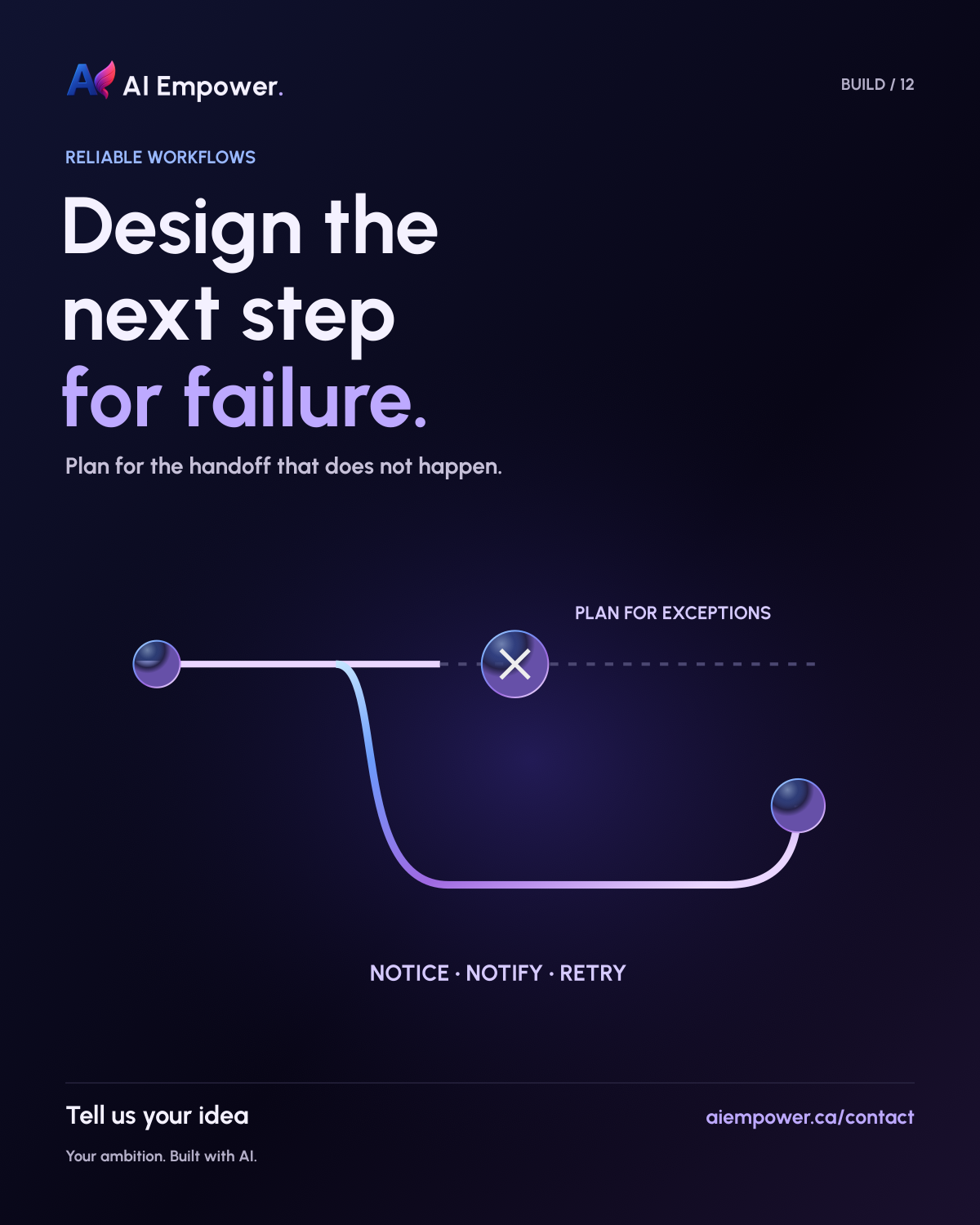
Distinguish a requested transfer from a confirmed connection, and rehearse a clear next step when nobody answers.
Define what a completed handoff means
Fictional handoff scenario
A caller asks for a person. The assistant says it is transferring them, plays a message and ends. Did an employee answer, did the caller reach a queue, or did the connection fail? Your design needs a different state for each outcome.
This guide proposes an original rehearsal for a routine business-information voice assistant. All dialogues and scenarios are fictional. It assumes no specific provider supports transfer, interruption, summaries or callbacks; each capability must be verified in the proposed implementation.
Agree on the finish line with the receiving team. Joining a queue, connecting to an employee and submitting a callback request are separate events. Name the evidence for each and write caller-facing language that matches it. A generated farewell is not connection evidence.
The opening choice
Make a request for a person a recognised route. Avoid forcing callers through a full automated questionnaire before they can use it. Ask only what is necessary to reach the appropriate team.
For a fictional service-information call, the assistant could say: “I can try the service team. Would you like me to pass along a short summary, or would you rather explain it yourself?” Offer this only if both routes really exist.
Consent boundaries
Keep permission for the summary separate from permission to collect a callback number or record a call. Declining a summary should leave a usable route to the team. A caller's silence should not be treated as agreement.
Use role-play and invented details during design. Before live use, have the responsible specialists assess recording, disclosure, data handling and other applicable requirements. This rehearsal is not a legal compliance assessment.
A correctable handoff note
Keep the proposed summary limited to the requested task and the unresolved question. Exclude unrelated personal details and the conversation's full transcript. Name the receiving team before asking to share it.
Fictional readback: “For the service team: you want to ask whether remote setup is available. Is that right?” The caller replies, “No, on-site setup.”
The assistant should replace that detail and read back the corrected summary for approval. It should not keep both versions as though the caller requested both services.
Google's conversation-design guidance recommends confirming message text before sharing it and allowing corrections without restarting the dialogue. Apply that principle to the short handoff note. Do not make the caller reconfirm every harmless conversational phrase.
If the note cannot be approved
If the caller declines to share the note, proceed through the verified no-summary route. If the correction remains unclear, stop trying to produce a polished summary and offer that route instead.
The failed-connection response
Prepare separate responses for an unavailable team, a technical connection failure and an unclear caller response. Google's error-design guidance distinguishes missing input, misunderstood input and system failures; its advice on system errors favours transparent explanations and useful next steps.
A fictional failed-transfer response might be: “I couldn't connect you. The service team's contact page is another way to ask your question. Would you like directions to it?” Use the business's verified destination and keep spoken instructions short. Never invent opening hours, a phone number or a response deadline.
If a callback route exists
If a callback route exists, explain what information it needs and obtain the caller's agreement. Read back essential contact details through the approved process. Confirm only that a callback request was submitted when the receiving system accepts it; do not promise a callback time without a supported commitment.
The implementation behind the words
Write a small state list with the implementer: handoff offered, caller chose a route, summary approved or declined, connection attempted, queue joined, employee connected, or attempt failed. Mark unsupported states as unavailable rather than writing dialogue that implies they exist.
-
Describe the observed state
Before initiating a supported transfer, language such as “I'll try to connect you now” describes the attempt. Say that an employee is connected only when the implementation provides that evidence. If it only confirms entry to a queue, describe the queue.
-
Verify recovery before the attempt
Test what happens to the original call while the destination rings. Can the assistant resume if nobody answers? Does the platform disconnect the caller? If recovery is unavailable, provide the verified alternative contact route before attempting transfer. Do not promise to return to the conversation unless that behaviour has been demonstrated.
Role-play both sides of the handoff
Use this test record for each invented call: caller goal; interruption or fault; expected words; permitted information transfer; required system evidence; fallback; and reviewer finding.
Caller choice and correction
-
Caller asks for a person immediately: verify the route works without unnecessary questions.
-
Caller corrects the summary: inspect what the employee receives and confirm that the old detail is gone.
Interruption timing
-
Caller says “wait” before connection begins: verify the attempt stops and the assistant asks what should change.
-
Caller interrupts after transfer has begun: check the actual call state before promising cancellation or starting a second route.
Failure and uncertainty
-
Destination does not answer: follow the tested recovery or pre-explained alternative.
-
Silence or background noise prevents understanding: use a bounded retry and then a usable alternative, without treating silence as consent.
-
Callback submission is uncertain: preserve that uncertainty and prevent a second request until the first outcome is checked.
Have one person play the caller and another inspect the receiving side. A pleasant caller experience can still conceal a missing note or an unowned request. Record failures and the evidence needed for a rerun.
Pause launch if the assistant falsely reports connection, shares an unapproved summary, or leaves callers with no usable route after failure. Begin with one receiving team and a complete rehearsal. Bring the results to a voice assistant discussion.
Week 10 · interactive local candidate
A handoff is an evidenced state
Fictional local exercise. This exercise keeps its working inputs in page memory and starts over on reset or reload. It does not automatically submit or save those inputs, call an AI or access accounts. Copies and printouts are outside reset; browser-managed history, extensions and device behaviour are outside this exercise’s control. Use invented examples only; do not enter personal records or credentials. No real transfers or independent verification are performed.
Correct “remote” to “on-site”, rehearse permission, then inject one system event. Queue, connection and callback receipt are distinct. All controls below operate an in-memory role-play only.
Current simulation: offered
Caller-facing words: I can try the service team. Choose whether to share a short note or explain it yourself.
Review pending. Change inputs, then review the current version. Earlier results are cleared after every edit.
Week 10: A handoff is an evidenced state
Fictional local exercise. This exercise keeps its working inputs in page memory and starts over on reset or reload. It does not automatically submit or save those inputs, call an AI or access accounts. Copies and printouts are outside reset; browser-managed history, extensions and device behaviour are outside this exercise’s control. Use invented examples only; do not enter personal records or credentials. No real transfers or independent verification are performed.
All observations and checks below are fictional or reader-reported; none independently verified.

FIXED FICTIONAL REFERENCE
{
  "job": "Permission for the current summary is separate from callback permission and any recording permission. Silence is not agreement.",
  "evidence": "Attempt, queue entry, employee connection and accepted callback request are distinct. Fixture buttons inject their own simulated evidence. A generated farewell supplies none.",
  "recovery": "If recovery is unavailable, explain a checked alternative before attempting. Unknown transfer/callback outcomes must not create a duplicate route.",
  "correction": "Replace remote with on-site in the authored example, read back and approve the changed note. Plan edits are locked while an attempt is pending or unresolved; explicit injected evidence can resolve that same attempt. Other plan edits restart the role-play, and changed fallback/team/transfer/recovery details need a fresh fallback check."
}

CURRENT INPUTS (fictional / reader-entered)
{
  "goal": "Ask whether on-site setup is available",
  "team": "Fictional service team",
  "note": "The caller wants to ask whether remote setup is available.",
  "route": "undecided",
  "approved": false,
  "transfer": true,
  "noSummary": true,
  "recovery": true,
  "fallback": "Fictional service contact page; no actual address supplied",
  "fallbackChecked": false,
  "callback": false,
  "callbackConsent": false,
  "stage": "offered",
  "event": "none",
  "unclearCount": 0,
  "trace": []
}

Review pending. No current result; any earlier review was invalidated by input changes.

LIMITATIONS AND WARNINGS
• Filled fields and reader-reported checks are not independent evidence or real business approval.
• Scripted events teach state distinctions. No call, transfer, callback, recording, summary transmission or real consent occurs. Capabilities and fallback are hypothetical, not provider claims.
• Silence or no route choice is not consent.
• Prepare an explicitly checked fictional fallback before the attempt.
Use the text-only exercise
The complete unchanged manuscript remains readable if the controls are unavailable.
Return to Role-play both sides of the handoffSources rechecked 4 October 2026
Sources & review
Primary sources checked on . The checklists and planning examples are AI-assisted editorial guidance, not source quotations or reported client results.
This AI-assisted guide uses fictional examples for practice. It does not report client results or establish that a live system will behave the same way.
Originally published: .