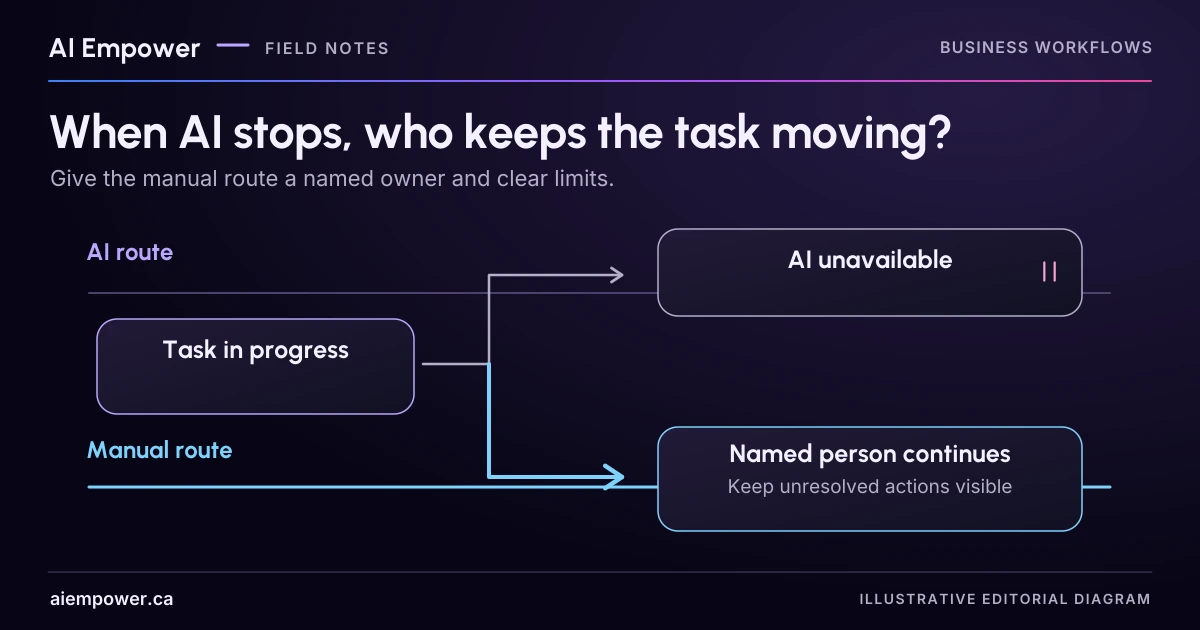
Keep unfinished-work ownership clear, use a bounded manual fallback and verify restart conditions before resuming the assistant.
The AI drafting assistant is unavailable, but the customer enquiries keep arriving. Which employee picks up the unfinished work, which source should they use and how do they know what has already happened?
A manual fallback is easier to use when it describes one task clearly. “Do it manually” leaves staff to reconstruct the process under pressure. Prepare a short continuation card and rehearse it without causing a real outage.
The example below concerns a fictional internal assistant that drafts replies about equipment collection. It cannot send the reply or approve an arrangement. Staff review and send through the organisation’s normal system. The exercise is a tabletop discussion, not live failure injection.
Define the failure you are handling
For this fictional workflow, the fallback begins when authorised staff cannot obtain a usable draft and the support owner confirms the drafting component is unavailable. The team does not need repeated failed attempts before using the approved manual route.
Different failures need different responses. A routine service outage is not the same as suspected unauthorised access, data exposure or malicious content. If there are signs of a security incident, follow the organisation’s incident process and involve the responsible specialists. Do not copy potentially compromised material into a new tool merely to keep work moving.
NIST’s AI RMF Core includes contingency, response and recovery planning. The card here is an original operating aid for one low-stakes drafting task, not a complete continuity or security plan.
Sort the unfinished work before restarting it
The intake coordinator reviews the existing queue and assigns each item a state:
| Work state | Manual continuation in this fictional workflow |
|---|---|
| Not drafted | Read the enquiry and current approved collection guide; prepare a manual draft |
| Draft exists, not checked | Review from the original enquiry and source; do not assume the draft is accurate |
| Reviewed, not sent | Confirm the reviewed version and continue through the normal authorised sending process |
| Send outcome unknown in the separate mail system | Retain ownership and verify that system’s evidence before retrying |
| Completed with evidence | Leave complete; do not recreate it because the drafting component failed |
The uncertain-send row belongs to the wider staff workflow, not to a capability of the read-only assistant. Keeping that distinction prevents an outage from becoming a reason to duplicate work that may already be complete.
Write the continuation card
Copy these fields into the team’s approved operating record:
- Task: Prepare a staff-reviewed reply about collection arrangements.
- Fallback trigger: The condition under which the drafting component is no longer relied on.
- Current source: Exact location and version of the approved collection guide.
- Owner and backup: Who allocates unfinished work and who covers absence.
- Manual steps: Read the original, identify the question, check the guide, draft, review and use the ordinary authorised completion route.
- Boundaries: No unsupported availability, no invented exception and no unverified promise.
- Unfinished-work record: Reference, state, owner, next action and supporting evidence.
- Support route: Who investigates the component and who can approve restoration.
Use links or references to authorised records rather than duplicating customer data into an informal outage spreadsheet. The fallback must respect the same access and handling boundaries as ordinary work.
Rehearse three arrivals
Give the team three fictional cards. First, a simple collection question whose answer is in the guide. Second, a request for an exception that requires a manager’s decision. Third, a reviewed reply with an uncertain send result in the separate email system.
Ask each employee to state the next action, the owner and the evidence needed. The first can proceed through the manual drafting process. The second remains unresolved until the authorised decision is available. The third requires reconciliation before another send. None should be labelled finished merely because a manual fallback has been activated.
Now remove the usual coordinator from the scenario. Can the backup find the queue and current guide with their own authorised access? If the fallback depends on another person’s password, an unavailable laptop or a source nobody can identify, record that as a gap. Resolve it through the normal approved access process, not by sharing credentials.
Week 50 · interactive local candidate
Rehearse the queue before restarting
Fictional local exercise. No live AI, sending, verification, backend, analytics or automatic storage/submission. Working inputs stay in page memory; reset/reload restores fixtures. Deliberate copies and printouts are outside reset. Browser/device behaviour is outside this exercise’s control. Use invented, non-sensitive details only.
Sort five work states, remove the usual coordinator, then inspect recovery gaps. All queue cards and mail evidence are invented. Selecting a next action does not execute it.
2. Assign each work item
Week 50: Manual-fallback tabletop
Record schema: local-rehearsal-v1
Fictional local exercise. No live AI, sending, verification, backend, analytics or automatic storage/submission. Working inputs stay in page memory; reset/reload restores fixtures. Deliberate copies and printouts are outside reset. Browser/device behaviour is outside this exercise’s control. Use invented, non-sensitive details only.
Entered prose and ticked checks are reader-reported, not independently validated. Completeness is not business approval or proof of safety.
These candidates do not publish or schedule articles, change any live workflow, or form a working year-long publishing system.

FIXED FICTIONAL REFERENCE
[
  {
    "id": "Q1",
    "label": "Simple collection question",
    "state": "Not drafted",
    "fact": "Approved Collection Guide v3 says collection is by confirmed appointment. The drafting helper cannot reserve a slot.",
    "next": "draft",
    "evidence": "Current guide and original question; staff review before the normal authorised sending route."
  },
  {
    "id": "Q2",
    "label": "Request for a Sunday exception",
    "state": "Not drafted; exception unresolved",
    "fact": "Guide v3 excludes Sunday collections. No manager decision is present.",
    "next": "hold",
    "evidence": "Authorised manager decision is missing. Keep ownership; do not promise an exception."
  },
  {
    "id": "Q3",
    "label": "Reviewed reply with uncertain send",
    "state": "Send outcome unknown in the separate mail system",
    "fact": "The mail window closed without a receipt. The assistant only drafted text.",
    "next": "reconcile",
    "evidence": "Separate mail-system evidence is needed before retrying; do not duplicate a potentially sent message."
  },
  {
    "id": "Q4",
    "label": "Draft waiting for review",
    "state": "Draft exists, not checked",
    "fact": "An unreviewed draft says the collection is confirmed, but the original enquiry requested a slot.",
    "next": "review",
    "evidence": "Check original question and guide; preserve unconfirmed status, then use normal review."
  },
  {
    "id": "Q5",
    "label": "Completed reply with receipt",
    "state": "Completed with evidence",
    "fact": "Fictional mail receipt M-205 identifies the reviewed reply and completed send.",
    "next": "leave",
    "evidence": "Keep the existing receipt; do not recreate completed work."
  }
]

CURRENT READER INPUTS
{
  "source": "Fictional approved records / Collection Guide",
  "version": "v3",
  "context": "Staff-reviewed collection replies; assistant drafts only",
  "coordinator": "Intake coordinator",
  "backup": "Backup coordinator",
  "absent": false,
  "access": false,
  "failure": "outage",
  "mail": "unknown",
  "rows": [
    {
      "id": "Q1",
      "owner": "",
      "action": "",
      "evidence": "",
      "checked": false
    },
    {
      "id": "Q2",
      "owner": "",
      "action": "",
      "evidence": "",
      "checked": false
    },
    {
      "id": "Q3",
      "owner": "",
      "action": "",
      "evidence": "",
      "checked": false
    },
    {
      "id": "Q4",
      "owner": "",
      "action": "",
      "evidence": "",
      "checked": false
    },
    {
      "id": "Q5",
      "owner": "",
      "action": "",
      "evidence": "",
      "checked": false
    }
  ],
  "support": "",
  "cause": "",
  "test": "",
  "approval": "",
  "restoration": false
}

Review pending. Previous conclusions are invalid after any input edit.

WARNINGS
• Fictional local exercise. No live AI, sending, verification, backend, analytics or automatic storage/submission. Working inputs stay in page memory; reset/reload restores fixtures. Deliberate copies and printouts are outside reset. Browser/device behaviour is outside this exercise’s control. Use invented, non-sensitive details only.
• Entered prose and ticked checks are reader-reported, not independently validated. Completeness is not business approval or proof of safety.
• These candidates do not publish or schedule articles, change any live workflow, or form a working year-long publishing system.
• Continuation gap: identify current source, version, scope, coordinator and backup, then record authorised access for the current scenario.
Use the text-only exercise
The complete unchanged manuscript remains readable if the controls are unavailable.
Return to Rehearse three arrivalsPlan the return to normal work
Restoring a login or seeing a green status page is only part of recovery. The support owner should confirm the cause and relevant repair, then test the component against approved examples. The operations owner reconciles the queue before reopening automatic entry points or directing staff back to the tool.
For each item, decide whether manual work is already complete, still in progress or waiting on evidence. Do not feed the entire queue back into the assistant and assume duplicates will be recognised. Verify the actual implementation’s retry and record-matching behaviour where those features exist.
Keep the fallback available until staff can use the restored component with the required sources and review steps. Record who approved the return and which checks were performed. If a cause remains unresolved, describe it rather than claiming the outage is fully understood.
Keep the card small enough to use
Finish the rehearsal with one card, a list of gaps and an owner for each. Review it when the source location, staffing arrangement, sending system or AI component changes. A fallback that worked under an old configuration may no longer lead to the right place.
The useful result is continuity with visible responsibility. Staff can keep the task moving while uncertainty remains attached to the items that need further checking.
Primary sources checked 4 October 2026
Sources & review
Primary sources checked on . The checklists and planning examples are AI-assisted editorial guidance, not source quotations or reported client results.
This AI-assisted guide uses fictional examples for practice. It does not report client results or establish that a live system will behave the same way.
Originally published: .