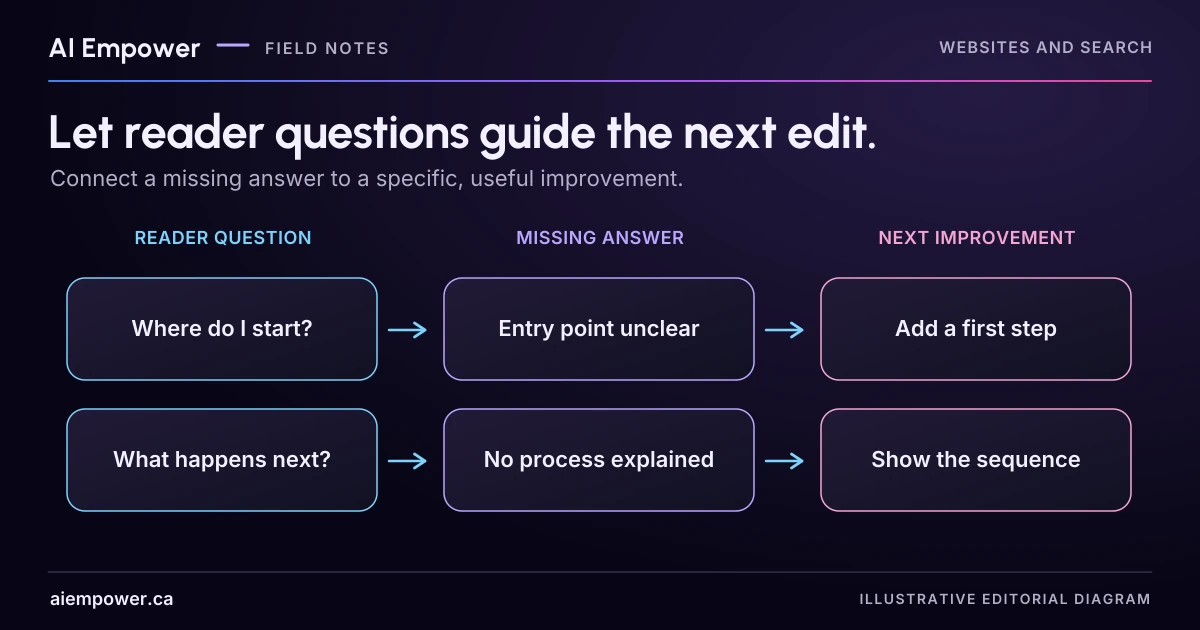
Turn traceable reader questions into a small queue of improvements with evidence needs, an owner and a clear reader benefit.
You have a list of older articles and a limited amount of time. Which one deserves attention next? Start with a reader who is blocked, a consequential claim that has changed or a question the page leaves unanswered.
An article’s age alone does not tell you whether it needs work. A recent page may contain a confusing instruction, while an older explanation may still be accurate and useful. Build a small evidence-to-update queue rather than assigning every URL an arbitrary freshness score.
The examples below are fictional editorial records. They do not represent actual reader feedback, search traffic or AI Empower results.
Turn a question into a specific gap
Imagine three items on an editorial board:
Article A: preparing a file for a service review. A fictional reader asks, “Which file version should I send if I changed the diagram?” The article describes file types but never explains version identification. Proposed improvement: add a short version-and-reference example and have the service owner verify it.
Article B: using an app’s export function. The product’s current documentation shows that the described export no longer includes an attachment type. Proposed improvement: verify the new behaviour and revise the affected steps and limitations. Readers following the old instructions could lose necessary context.
Article C: choosing a homepage image. The cover feels dated, but there is no verified problem with the article’s explanation or image alternatives. Proposed improvement: optional visual refresh after higher-consequence gaps are addressed.
The board makes the reasons visible. Article B needs prompt attention because an instruction may mislead someone. Article A has a clear learning benefit. Article C may still be worth improving, but its case is different.
Use evidence you can trace
Useful inputs include questions asked through an authorised feedback route, support topics linked to a page, usability observations, source changes and a reviewer’s inability to complete the article’s exercise. Record where the evidence came from and when it was observed.
Keep personal details out of the editorial board unless they are genuinely needed and appropriately handled. A question can often be paraphrased: “Reader could not identify which version to submit.” Link to the authorised source for the person who needs to verify it rather than copying a private conversation into a widely shared tracker.
Analytics can help when available, but interpret the metric. Page views do not reveal which paragraph confused someone. A low-traffic article can still contain an important error, and a popular page can still need a small, targeted repair. Do not infer a reader’s intent from a number alone.
Build one card per proposed improvement
Each card needs six elements:
- Article and location: The verified URL and relevant passage or exercise.
- Observed reader question or defect: What happened, without adding a speculative diagnosis.
- Reader consequence: What a person cannot understand or do, or what they might misunderstand.
- Proposed improvement: The smallest useful addition, correction or review.
- Evidence still needed: Source, product observation, subject reviewer or reader check.
- Owner and next decision: Who will resolve the gap and what closes the item.
Avoid cards such as “Improve SEO” or “Make more engaging.” They do not identify the help the reader will receive or the evidence needed to judge it.
Week 51 · interactive local candidate
Choose an improvement with a reason
Fictional local exercise. No live AI, sending, verification, backend, analytics or automatic storage/submission. Working inputs stay in page memory; reset/reload restores fixtures. Deliberate copies and printouts are outside reset. Browser/device behaviour is outside this exercise’s control. Use invented, non-sensitive details only.
Prepare a small editorial queue. The instruction conflict, learning gap and optional visual preference have different consequences. There is no freshness score or automatic ranking. This fictional board is dated 2026-10-04; use real YYYY-MM-DD evidence dates on or before that date. Missing or invalid dates can justify a verification task, but cannot support an edit.
Week 51: Evidence-to-update prioritization
Record schema: local-rehearsal-v1
Fictional local exercise. No live AI, sending, verification, backend, analytics or automatic storage/submission. Working inputs stay in page memory; reset/reload restores fixtures. Deliberate copies and printouts are outside reset. Browser/device behaviour is outside this exercise’s control. Use invented, non-sensitive details only.
Entered prose and ticked checks are reader-reported, not independently validated. Completeness is not business approval or proof of safety.
These candidates do not publish or schedule articles, change any live workflow, or form a working year-long publishing system.

FIXED FICTIONAL REFERENCE
[
  {
    "id": "A",
    "title": "Preparing a file for a service review",
    "location": "https://example.invalid/file-review#versions",
    "observation": "A fictional reader could not identify which changed-diagram version to send.",
    "consequence": "Reader cannot identify the intended version reliably.",
    "proposal": "Add one version-and-reference example; verify it with the service owner.",
    "evidence": "Fictional authorised feedback F-12, 2026-09-28; paraphrased without personal details.",
    "kind": "reader",
    "scope": "Version-identification explanation"
  },
  {
    "id": "B",
    "title": "Using an app’s export function",
    "location": "https://example.invalid/export#attachments",
    "observation": "Fictional product documentation v4 says attachment type DISPLAY-B is excluded. The article still says it is included.",
    "consequence": "Readers could lose essential diagram context.",
    "proposal": "Verify a current export, then revise only affected steps and limitations.",
    "evidence": "Fictional product documentation DOC-4, 2026-09-29; export behaviour not yet observed.",
    "kind": "accuracy",
    "scope": "Attachment inclusion claim"
  },
  {
    "id": "C",
    "title": "Choosing a homepage image",
    "location": "https://example.invalid/homepage-image#cover",
    "observation": "The cover feels dated. No reader defect has been observed.",
    "consequence": "Reader impact has not been established.",
    "proposal": "Optional visual refresh after consequential gaps; investigate before inventing a benefit.",
    "evidence": "Fictional editorial preference note P-7, 2026-09-30.",
    "kind": "optional",
    "scope": "Cover appearance only"
  }
]

CURRENT READER INPUTS
{
  "context": "Improve one useful explanation; no SEO score or traffic promise",
  "selected": "B",
  "action": "verify",
  "reason": "",
  "rows": [
    {
      "id": "A",
      "location": "https://example.invalid/file-review#versions",
      "version": "Article v1",
      "observation": "A fictional reader could not identify which changed-diagram version to send.",
      "consequence": "Reader cannot identify the intended version reliably.",
      "proposal": "Add one version-and-reference example; verify it with the service owner.",
      "evidence": "Fictional authorised feedback F-12, 2026-09-28; paraphrased without personal details.",
      "needed": "Service owner checks example; colleague identifies the intended fictional version.",
      "owner": "",
      "closure": "",
      "verified": false,
      "observationStatus": "unverified"
    },
    {
      "id": "B",
      "location": "https://example.invalid/export#attachments",
      "version": "Article v1",
      "observation": "Fictional product documentation v4 says attachment type DISPLAY-B is excluded. The article still says it is included.",
      "consequence": "Readers could lose essential diagram context.",
      "proposal": "Verify a current export, then revise only affected steps and limitations.",
      "evidence": "Fictional product documentation DOC-4, 2026-09-29; export behaviour not yet observed.",
      "needed": "Observe current export with DISPLAY-B and compare the approved documentation.",
      "owner": "",
      "closure": "",
      "verified": false,
      "observationStatus": "unverified"
    },
    {
      "id": "C",
      "location": "https://example.invalid/homepage-image#cover",
      "version": "Article v1",
      "observation": "The cover feels dated. No reader defect has been observed.",
      "consequence": "Reader impact has not been established.",
      "proposal": "Optional visual refresh after consequential gaps; investigate before inventing a benefit.",
      "evidence": "Fictional editorial preference note P-7, 2026-09-30.",
      "needed": "Establish a specific reader need before treating visual age as a defect.",
      "owner": "",
      "closure": "",
      "verified": false,
      "observationStatus": "unverified"
    }
  ]
}

Review pending. Previous conclusions are invalid after any input edit.

WARNINGS
• Fictional local exercise. No live AI, sending, verification, backend, analytics or automatic storage/submission. Working inputs stay in page memory; reset/reload restores fixtures. Deliberate copies and printouts are outside reset. Browser/device behaviour is outside this exercise’s control. Use invented, non-sensitive details only.
• Entered prose and ticked checks are reader-reported, not independently validated. Completeness is not business approval or proof of safety.
• These candidates do not publish or schedule articles, change any live workflow, or form a working year-long publishing system.
• Explain the reader benefit and why this is the next action; no automatic ranking is supplied.
Use the text-only exercise
The complete unchanged manuscript remains readable if the controls are unavailable.
Return to Build one card per proposed improvementChoose using reasons rather than a magic score
Review urgent accuracy and safety concerns first. Then compare the remaining items by the strength of the evidence, the importance of the reader task, the usefulness of the proposed repair and the work needed to verify it.
Do not let a simple numerical score hide a missing fact. If an update depends on a product behaviour nobody has checked, mark it blocked on verification. You can still repair an independently verified broken link elsewhere on the page, but that does not close the unresolved instruction.
Google’s people-first content guidance encourages assessing whether readers gain a satisfying answer and whether content is trustworthy. Use those questions as editorial prompts. This board does not predict search rankings or guarantee commercial results.
Try a small review cycle
Choose five articles with a clear relationship to the business’s current services. For each, inspect the principal reader task, current sources and any available feedback. Create a card only when you can name an actual gap or a specific verification need.
Select one update to complete. Keep its scope narrow enough to finish, check and explain. For example, add the version-identification example to Article A, ask the owner to verify it and have a colleague use it to identify the correct fictional file. The observation from that check is evidence about the revised explanation, not proof of a site-wide outcome.
At the next review, ask whether the completed change answered the original question. If new feedback shows the same gap, revise the explanation or investigate the surrounding journey. Do not repeatedly add paragraphs without understanding why the reader remains stuck.
Keep the queue connected to publication
When an update is complete, record what changed, the source check and any public revision note required by the site’s policy. Leave unrelated issues open. Remove items that no longer have a useful purpose rather than keeping them indefinitely because someone once suggested them.
Your finished queue should be short enough that each item has an understandable next action. A handful of well-supported improvements can be more useful than a long content audit with no owner or stopping condition.
Primary sources checked 4 October 2026
Sources & review
Primary sources checked on . The checklists and planning examples are AI-assisted editorial guidance, not source quotations or reported client results.
This AI-assisted guide uses fictional examples for practice. It does not report client results or establish that a live system will behave the same way.
Originally published: .