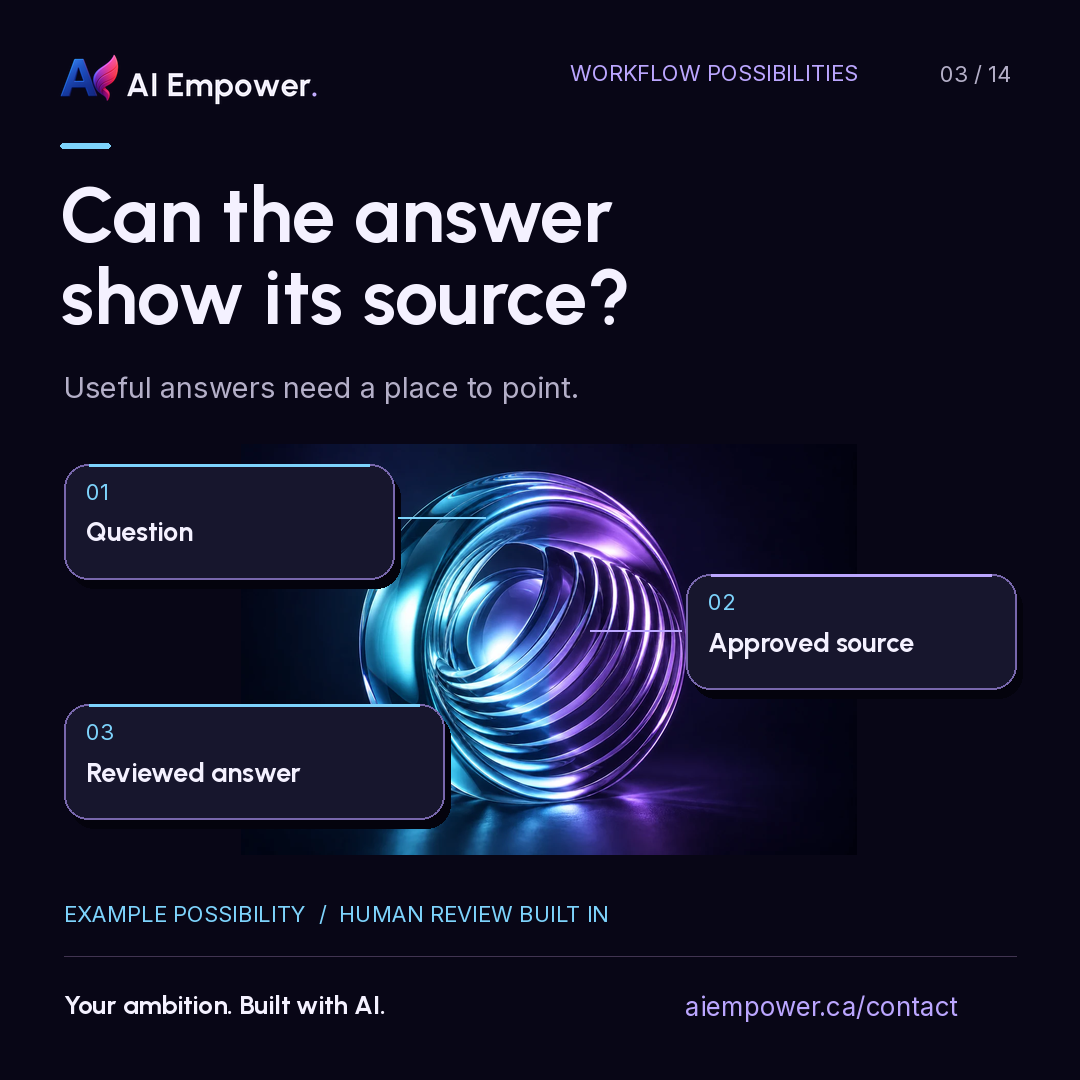
Follow two fictional enquiries from an approved source pack to a checked draft, keeping missing session information unresolved.
A small task you can follow
Imagine a Canadian adult-training provider whose staff answer questions about course formats, published prerequisites and session locations. The proposed pilot prepares a reply for a staff member to check. A staff member still decides what to send.
Everything in this walkthrough is fictional, including the provider, course, source pack and enquiries. It illustrates an operating method, not an AI Empower client engagement or a live course offering. No pilot results are claimed.
If you are still deciding which task to try, start with our first AI project guide. Here, the task has already been selected. The useful question is what should happen between opening an enquiry and sending an accurate reply.
Prepare a fictional source pack
For this exercise, the provider designates the following material as its approved source pack. “Approved” describes the fictional workflow; these are not actual institutional documents.
-
COURSE-A: Course overview. The fictional Introduction to Workplace Spreadsheets course is instructor-led and delivered live online. It is not described as self-paced.
-
ENTRY-A: Published prerequisites. Participants should be able to open a browser and save a file. Previous spreadsheet experience is not listed as a prerequisite. This page does not assess an individual's eligibility.
-
SESSION-A: Session directory. Session-specific arrangements belong here. The exercise supplies no current session listing, dates, prices, classroom address or seat availability.
-
CONTACT-A: Staff routing note. Questions the pack cannot answer go to the course-information coordinator. The draft must identify the missing fact rather than promise a response time.
Give each item an owner and a version label in the working copy. Keep the wording beside the source label so the reviewer can inspect it without searching several folders. A source label helps staff trace a sentence; the label alone does not prove that the sentence is supported.
Keep the input small
Begin with synthetic enquiries. Canadian privacy regulators recommend synthetic or de-identified information when personal information is unnecessary. This exercise uses entirely invented messages.
For this pilot, staff select only the public-information question for drafting. Names, signatures, attachments and personal histories have no role in the test input. Keep learners' records, grades, admissions decisions, information about minors, and funding or immigration advice completely outside the pilot.
If a real message mixes a simple format question with an excluded subject, staff handle it through the normal process. Do not upload the whole message and ask the assistant to sort out the boundary afterward. The fictional pilot has no connection to a student record system and no authority to enrol anyone.
Enquiry one: answer the supported parts
Fictional incoming enquiry: “Is Introduction to Workplace Spreadsheets a self-paced course? Do I need previous spreadsheet experience?”
Illustrative reply for staff review: “The course overview describes live, instructor-led online delivery. The published prerequisites are being able to open a browser and save a file; previous spreadsheet experience is not listed as a prerequisite.”
A useful internal review note would say:
-
Delivery statement: supported by COURSE-A.
-
Prerequisite statement: supported by ENTRY-A.
-
Session dates, prices and availability: not requested and not supplied.
The reviewer checks the actual wording. “Previous experience is not listed” must not become “everyone is eligible,” “you will find it easy,” or “you are guaranteed a place.” Those additions would go beyond the supplied facts. The draft also should not add an invitation to book a specific session when no current listing has been provided.
The final customer reply can include the provider's real public links once staff have verified them. The source labels in this exercise are internal review aids, not links a prospective learner could use.
Enquiry two: show the gap
Fictional incoming enquiry: “Can I attend in a classroom instead? Is there a session this Saturday?”
The pack describes online delivery and contains no current session entry. A good result separates a supported statement from work that still belongs to staff.
Illustrative draft: “The course overview currently describes live online delivery. I need to check with our course-information coordinator about any classroom option and the session you asked about.”
Internal handoff: “Confirm whether a classroom option exists and check the current session directory for the requested day. SESSION-A has no current listing in the supplied pack. Do not confirm a date, venue or availability from this draft.”
Staff must make that check before sending a more specific answer. If they choose to send an acknowledgement first, they must also take ownership of the follow-up. The draft cannot quietly create a promise that nobody tracks.
An answer that simply says “yes, Saturday is available” fails the exercise. So does an answer that claims classroom delivery is impossible: absence from this source pack does not settle what the provider offers elsewhere.
Compare with the manual reply
Use these same enquiries for a manual baseline. Ask staff to answer from the same pack without AI, then try the drafting workflow. Keep the expected facts and required handoffs fixed in both versions.
Record the whole task: reading the question, looking up facts, preparing wording, checking the draft and arranging any handoff. Note unsupported statements, missed questions, unclear wording and corrections. A faster first draft can still require a slower review.
Rotate the order of the methods or use comparable fresh examples so that familiarity with the answer does not dominate the comparison. Include routine questions and questions with missing information. Keep the observations separate from any assumptions about future enquiry volume.
There are no test results in this article. A real decision needs the provider's own observations. If a short reply template produces equally good answers with less upkeep, that is a useful result too.
Week 17 · interactive local candidate
Build a source-linked course reply
Fictional local exercise. No AI backend, automatic input submission, analytics, application storage, actual approvals, messages or business changes. Static page assets may load normally. Reset or reload clears this exercise’s working state, not copies, printouts or browser/device-managed data. Use invented details only. A completed exercise is not release approval.
Review pending. Change inputs, then review the current version. Earlier results are cleared after every edit.
Week 17: Build a source-linked course reply
Fictional local exercise. No AI backend, automatic input submission, analytics, application storage, actual approvals, messages or business changes. Static page assets may load normally. Reset or reload clears this exercise’s working state, not copies, printouts or browser/device-managed data. Use invented details only. A completed exercise is not release approval.
All observations and checks below are fictional or reader-reported; none independently verified.

FIXED FICTIONAL EXERCISE CONTEXT
{
  "sources": [
    "COURSE-A vA: live online, instructor-led Introduction to Workplace Spreadsheets. Not described as self-paced.",
    "ENTRY-A vA: open a browser and save a file. Previous spreadsheet experience not listed; individual eligibility is not assessed.",
    "SESSION-A vA: no current listing, dates, prices, classroom address or availability supplied.",
    "CONTACT-A vA: course-information coordinator handles missing facts; no response-time promise."
  ],
  "enquiries": {
    "routine": "Is Introduction to Workplace Spreadsheets self-paced? Do I need previous spreadsheet experience?",
    "missing": "Can I attend in a classroom instead? Is there a session this Saturday?",
    "excluded": "Can you decide whether my fictional child qualifies for funding and enrolment?"
  }
}

CURRENT INPUTS (fictional / reader-entered)
{
  "enquiry": "routine",
  "source": "present",
  "delivery": "omit",
  "entry": "omit",
  "session": "omit",
  "owner": "course-information coordinator",
  "note": ""
}

Review pending. No current result; any earlier review was invalidated by input changes.

LIMITATIONS AND WARNINGS
• All states are fictional or reader-reported. This exercise does not validate a real source, approval, system or outcome.
• Source labels are internal review aids, not customer links. Staff must inspect wording and decide what to send.
• The delivery question has no proposed answer.
• The prerequisites question remains unanswered.
Use the text-only exercise
The complete unchanged manuscript remains readable if the controls are unavailable.
Return to Compare with the manual replyDecide what earns another test
Before the trial, agree what would justify continuing: supported answers, visible gaps, a workable staff handoff and an acceptable total review effort. Keep an error example with its expected correction so it can be tested again.
Pause the affected workflow if it invents session details, answers an excluded question or loses the staff-review step. Fix the specific cause and repeat the relevant examples before using it again. A small demonstration cannot establish that all future questions will be handled correctly.
The next useful deliverable is a reviewed source pack and a record of what happened on each test. For a conversation about applying this approach to your own workflow, explore AI consultancy.
Sources rechecked 4 October 2026
Sources & review
Primary sources checked on . The checklists and planning examples are AI-assisted editorial guidance, not source quotations or reported client results.
This AI-assisted guide uses fictional examples for practice. It does not report client results or establish that a live system will behave the same way.
Originally published: .