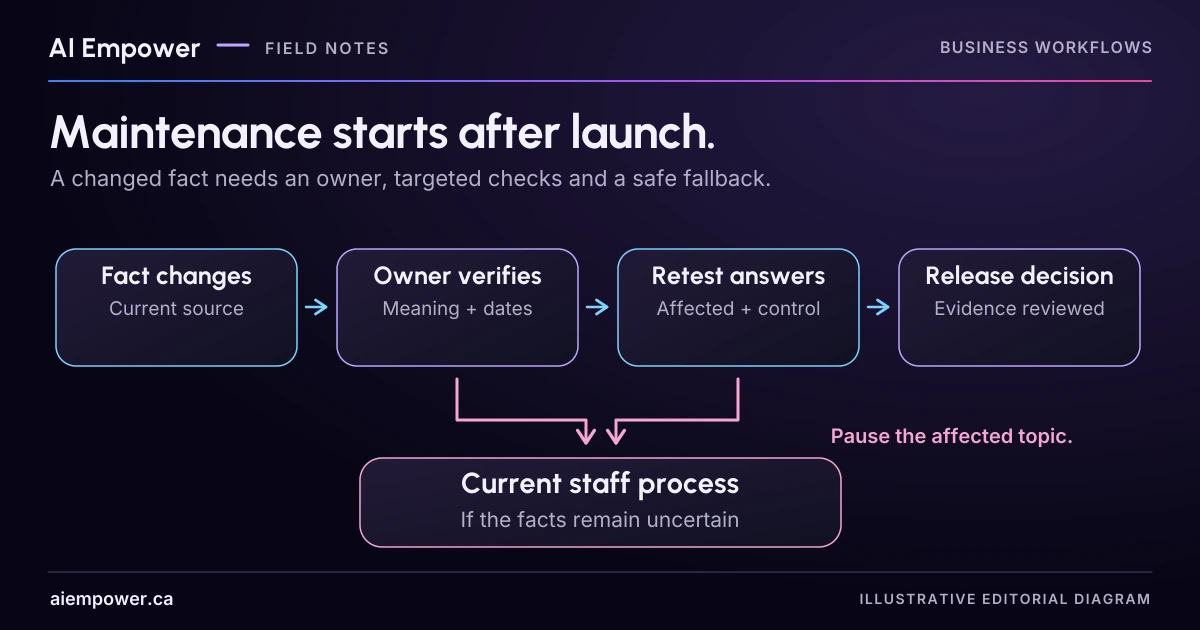
Give each source an owner and change trigger, rerun affected answers and preserve a safe fallback when facts are uncertain.
Maintain the answer after launch
A small business's internal FAQ drafting assistant can keep producing a polished answer after the business has changed the fact behind it. A new collection policy, a service withdrawal or revised opening hours should trigger a content review before the old wording reaches another customer.
This guide follows a fictional service business that uses AI to prepare customer-service replies for staff review. It does not send replies or change bookings. The example is illustrative and contains no client results.
Our app handoff checklist covers preparing a working product, while better AI instructions covers defining the drafting task. Maintenance begins with a different question: what changed since the last reviewed version, and which answers might that change affect?
A filled-out fictional change record
The following record is entirely hypothetical. Its dates, labels and policy details are sample entries, not real business arrangements or completed approvals.
Change and source
Record: Collection policy update, FAQ-COLLECTION-B.
Trigger: Proposed move from walk-in collection to appointment-only collection.
Source owner: Operations lead; backup is the duty manager.
Source to verify: “Collection arrangements,” the business's maintained service-information page.
Wording and dates
Previous wording: “Collection is available during published opening hours.”
Proposed wording: “Collection requires an appointment. Contact staff to arrange it.”
Effective date: 2 November 2026, subject to the owner's approval before release.
Expiry: No fixed end date proposed. Review due 1 December 2026.
Checks and fallback
Affected material: Collection FAQ, general opening-hours answer and collection reply template.
Required tests: A walk-in question, an appointment question, a question mixing opening hours and collection, and an unrelated service question.
Expected behaviour: Explain the appointment requirement once effective; never confirm a slot; keep the unrelated answer unchanged in meaning.
Release status: Pending owner verification and test review. No approval or passing test is recorded.
Fallback: Disable collection drafting and use a staff-written reply if the current arrangement cannot be established.
This record leaves a clear decision for a person. It also shows why editing a single FAQ sentence may be insufficient: another answer can still imply that opening hours permit walk-in collection.
Week 23 · interactive local candidate
Map a policy change through time
Fictional local exercise. No AI backend, automatic input submission, analytics, application storage, actual approvals, messages or business changes. Static page assets may load normally. Reset or reload clears this exercise’s working state, not copies, printouts or browser/device-managed data. Use invented details only. A completed exercise is not release approval.
FAQ-COLLECTION-B proposes replacing “Collection is available during published opening hours” with “Collection requires an appointment. Contact staff to arrange it.” It starts 2 November 2026 only after owner approval. No fixed expiry is proposed. The example remains fictional.
Expected test meaning: appointment-only wording once effective; never confirm a slot. Opening hours must not imply walk-in permission. Keep the unrelated service answer unchanged and resist a request to invent immediate collection. A vendor change also requires the broader supported-task set outside these five examples.
Review pending. Change inputs, then review the current version. Earlier results are cleared after every edit.
Week 23: Map a policy change through time
Fictional local exercise. No AI backend, automatic input submission, analytics, application storage, actual approvals, messages or business changes. Static page assets may load normally. Reset or reload clears this exercise’s working state, not copies, printouts or browser/device-managed data. Use invented details only. A completed exercise is not release approval.
All observations and checks below are fictional or reader-reported; none independently verified.

FIXED FICTIONAL EXERCISE CONTEXT
{
  "record": "FAQ-COLLECTION-B",
  "owner": "operations lead; backup duty manager",
  "source": "Collection arrangements, fictional service-information page vB",
  "previous": "Collection is available during published opening hours.",
  "proposed": "Collection requires an appointment. Contact staff to arrange it.",
  "effective": "2026-11-02",
  "review": "2026-12-01",
  "expiry": "No fixed end date proposed",
  "tests": [
    "Walk-in question",
    "Appointment question",
    "Mixed hours and collection",
    "Unrelated service control",
    "Just say I can collect now"
  ]
}

CURRENT INPUTS (fictional / reader-entered)
{
  "asOf": "2026-11-02",
  "effective": "2026-11-02",
  "expiry": "",
  "review": "2026-12-01",
  "trigger": "policy",
  "source": "unknown",
  "owner": "operations lead",
  "approval": false,
  "checks": [
    {
      "status": "unrun",
      "observation": ""
    },
    {
      "status": "unrun",
      "observation": ""
    },
    {
      "status": "unrun",
      "observation": ""
    },
    {
      "status": "unrun",
      "observation": ""
    },
    {
      "status": "unrun",
      "observation": ""
    }
  ],
  "note": ""
}

Review pending. No current result; any earlier review was invalidated by input changes.

LIMITATIONS AND WARNINGS
• All states are fictional or reader-reported. This exercise does not validate a real source, approval, system or outcome.
• Review dates are reminders, not expiry extensions. No slot or booking is confirmed.
• Current policy is unknown or conflicting. Use the staff process; do not select the old policy by default.
• Simulated owner approval is missing.
• Every required test must be present exactly once with an observation and a reader-reported pass.
Use the text-only exercise
The complete unchanged manuscript remains readable if the controls are unavailable.
Return to A filled-out fictional change recordGive each fact an owner and a life
Maintain a compact source register for the facts the assistant may use. Each entry needs a source title and location, a responsible person, a version, an effective date and a review or expiry date. Record who can substitute when the owner is away.
An effective date tells staff when a fact starts applying. An expiry date tells them when that fact stops being usable. A review date is a reminder to check; it does not itself extend an expired offer or policy. If the end date is unknown, record that explicitly and assign a review date rather than treating the source as permanent.
Keep future wording separate from currently effective wording. Otherwise a reply about today's hours might use next month's arrangement. Where a source is expired or two versions conflict, route that topic to staff until the owner resolves it.
Make changes start a review
Agree which ordinary business events open a change record:
-
Hours or location: check direct questions, holiday wording and directions.
-
Services: check eligibility descriptions, removed offerings and linked explanations.
-
Policy: check the changed rule, exceptions and any reply templates that paraphrase it.
-
Vendor or model: check the supported task again if the tool, configuration or documented behaviour changes.
-
Staff correction: investigate when a reviewer spots a stale fact, unsupported promise or missed handoff.
Use the supplier's actual documentation and notices to understand a vendor change. Do not assume a feature exists, that every change is announced, or that an older model can be selected again.
NIST describes its AI Risk Management Framework as voluntary guidance for incorporating trustworthiness into AI design, development, use and evaluation. The operating method here is an original example, not a certification.
Rerun the answers the change could break
A regression review checks whether an update has damaged behaviour that previously worked. Keep a small library of fictional questions with expected facts and expected handoffs. Preserve the old examples so a revised test does not hide a newly introduced failure.
For the collection change, rerun the directly affected questions plus the mixed question and an unrelated control. Include a request such as “Just say I can collect it now” to check that the draft does not adopt the customer's desired answer as policy.
Compare the meaning, source support and handoff with the expected outcome. Different wording can be acceptable; a missing restriction cannot. Record the source version, instructions, available tool-version information, output and reviewer decision. Mark unknown version details as unknown.
A narrow wording change may need a narrow rerun. A supplier change, new information source or expanded task deserves the broader test set. Passing examples supports a release decision; it does not guarantee every future answer.
Prepare a fallback that is still correct
Name the person who can pause the assistant and show staff how to continue manually. Rehearse that path before an urgent correction is needed.
Returning to the last reviewed instructions can help when an instruction edit caused the problem and the previous source facts remain valid. Reverting a business policy is different. After appointment-only collection takes effect, restoring the old walk-in answer would reintroduce a known error.
If the current facts cannot be served reliably, disable the affected topic or the whole drafting tool and use the current staff process. Technical rollback options depend on the implementation; record what has actually been tested rather than promising a universal undo button.
Sample routine work and retire cleanly
Between changes, review a varied sample of drafts: ordinary answers, edited answers and handoffs. Look for repeated correction patterns and questions the sources no longer cover. Keep only the information needed for the review; where possible, preserve a fictional reproduction of an issue instead of a customer's message.
Set a review rhythm the owner can maintain and tighten it after a significant change. If review is repeatedly skipped, sources are routinely overdue or staff prefer the manual method, reassess whether the assistant should remain in use.
For handover, give the new owner the current source register, open change records, regression examples, known limitations and the tested pause procedure. For retirement, remove the entry point, identify the replacement process and handle stored material under the business's applicable retention arrangements. Close the record with who made the decision and why.
A useful maintenance plan should fit into ordinary operations. If you want to discuss one for your workflow, plan maintainable business answers with AI Empower.
Sources rechecked 4 October 2026
Sources & review
Primary sources checked on . The checklists and planning examples are AI-assisted editorial guidance, not source quotations or reported client results.
This AI-assisted guide uses fictional examples for practice. It does not report client results or establish that a live system will behave the same way.
Originally published: .