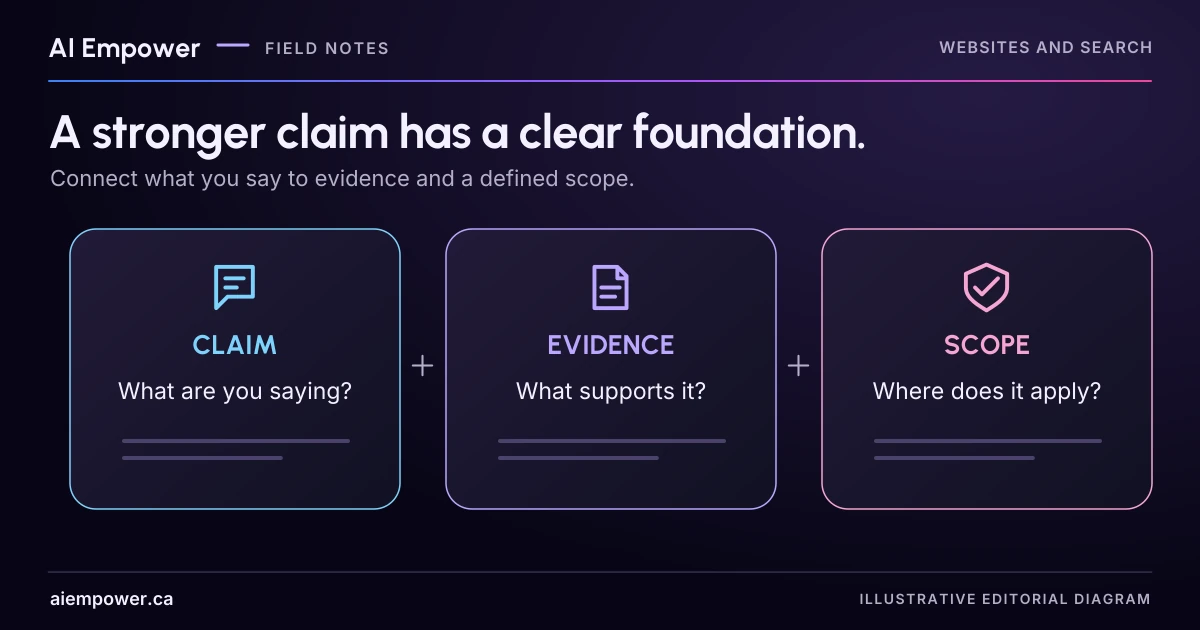
Tie each marketing claim to its evidence, scope and remaining uncertainty; remove unsupported quantities and promises.
“We save every team ten hours a week.” Before publishing a sentence like that, ask which teams, doing what work, compared with which method, over what period. If the evidence cannot answer those questions, the sentence is doing more work than the product has demonstrated.
A useful marketing review connects each promise to support that is specific enough for a reader to understand. This article provides an original claim-checking exercise, using fictional examples. None of the numbers or products below describes an AI Empower client result.
Separate a capability from a measured outcome
A capability describes something the product can do in the version and configuration being offered. A demonstration shows what happened in one prepared setting. A measured outcome describes an observed change under stated conditions. A guarantee adds a commitment that needs its own authority and terms.
These categories are easy to blur. Showing a draft appear on screen supports the observation that a draft appeared in that demonstration. It does not establish that the customer will save time after checking it. A system that prepares an email does not necessarily send it. A design mock-up can show a proposed experience without establishing that the underlying integration works.
Begin by underlining the verbs and quantities in your copy. Words such as “books,” “saves,” “eliminates,” “always” and “guarantees” deserve an exact evidence question. Include claims in captions, diagrams, metadata and button labels, not just the opening paragraph.
Claim one needs a fair denominator
Fictional draft: “Our AI cuts enquiry work by 50%.”
Fictional evidence: a presenter generated one first draft in half the time they took to write another first draft. Nobody timed review, corrections, failed attempts or upkeep, and the two enquiries were different.
That evidence does not support the advertised handling-effort reduction. Adding “up to” does not repair the missing comparison. A more defensible sentence for this fictional situation is: “See a demonstration of an enquiry draft prepared from a supplied information sheet. Staff review is still required.” Even that sentence needs the demonstrated capability to be real in the offered version.
If you want to make a measured time claim, collect the evidence first. Define comparable tasks and a common finish line, retain failures, measure review effort and explain the observation period. A small pilot result should stay visibly tied to that pilot. Do not convert it into a promise for every future customer.
Canada's Competition Bureau guidance on performance claims says relevant performance claims require adequate and proper testing before the claim is made. The worksheet here is an editorial screen, not a determination that a particular claim or test meets legal requirements. Obtain qualified review when that judgement is needed.
Claim two hides a human decision
Fictional draft: “Book every appointment automatically, day or night.”
Fictional evidence: a prototype gathers a preferred day and passes the request to staff. It has no live calendar connection and cannot confirm a slot.
A truthful rewrite is: “This prototype collects an appointment preference for staff review. It does not confirm a booking.” If the product later adds a tested calendar integration, revisit the wording against that implementation. Do not let a future roadmap feature become present-tense copy.
Check the image too. A bright “Booking confirmed” screen contradicts the honest sentence beneath it. A caption saying “illustration” may still leave the wrong impression if the whole demonstration presents the screen as a completed transaction. Show the actual request state and identify simulated screens where they appear.
Claim three asks the evidence to prove too much
Fictional draft: “Accurate answers to any customer question.”
Fictional evidence: ten approved FAQ questions produced answers a reviewer accepted. Questions outside the FAQ, conflicting policies and unavailable sources were not tested.
The evidence supports a narrower account: “In this fictional test, a reviewer accepted the answers to ten supplied FAQ questions. The test did not cover other questions.” That sentence is suitable as an explanation of the invented exercise, not as product advertising. For real marketing, use actual permission-cleared results with their methods and limits, or describe a verified capability without inventing an outcome.
Removing “any” alone may not be enough. “Accurate answers” can still suggest a general result the trial has not established. Explain the approved information boundary and the staff review role in the main promise rather than relying on a footnote to reverse it.
Make a claim record another person can inspect
For each proposed sentence, record:
- Exact wording and every place it appears.
- What a reasonable reader might understand it to promise.
- Evidence type, version, date and owner.
- Task, population, period and exclusions covered by the evidence.
- What remains unknown or contradicts the claim.
- Decision: retain, narrow, label as a proposal, or remove.
Then read the revised sentence without the surrounding explanation. Does it still sound broader than the support? Ask an unfamiliar colleague to paraphrase the promise. Record their interpretation; do not coach them toward the intended caveat.
A useful finished record might say: “Remove the weekly-hours claim. Keep the staff-reviewed drafting demonstration, labelled with fictional inputs. Request a matched handling-effort study before considering quantified copy.” That is a concrete publication decision without a fabricated result.
Week 8 · Fictional local practice
Rewrite the promise to fit the evidence
A claim-by-claim editorial record, with the evidence and limits attached.
Use fictional, non-sensitive values only. Entries remain in page memory. No uploads, storage or network requests are made by this activity. Copy and print occur only when selected.
Three fictional evidence packets. Classify what each packet actually shows, then make an editorial decision. Your wording is never automatically graded or approved for advertising or legal compliance.
Take your record with you
Includes all current choices, source limits and unanswered fields. Copy and print happen only when you choose.
Scoped claim editorial record · local practice v1
Local fictional practice only. No real business facts, outcome, legal compliance, accessibility, search performance or live account state are validated. Entries stay in page memory; no network requests, analytics or persistence. Refresh clears work. Do not enter personal or confidential information.


Claim 1: Our AI cuts enquiry work by 50%.
Supplied fictional evidence: a presenter generated one first draft in half the time they took to write another first draft. Nobody timed review, corrections, failed attempts or upkeep, and the two enquiries were different.
Evidence scope choice: Not recorded; decision: Not recorded
Reader interpretation: Not recorded
Draft rewrite (not evaluated): Not recorded
Unknowns / contradictions: Not recorded
Locations: Not recorded
Evidence owner: Not recorded; version: Not recorded; date: Not recorded
Worked reasoning not yet revealed
Review when service tier, information sources, workflow or integration changes.

Claim 2: Book every appointment automatically, day or night.
Supplied fictional evidence: a prototype gathers a preferred day and passes the request to staff. It has no live calendar connection and cannot confirm a slot.
Evidence scope choice: Not recorded; decision: Not recorded
Reader interpretation: Not recorded
Draft rewrite (not evaluated): Not recorded
Unknowns / contradictions: Not recorded
Locations: Not recorded
Evidence owner: Not recorded; version: Not recorded; date: Not recorded
Worked reasoning not yet revealed
Review when service tier, information sources, workflow or integration changes.

Claim 3: Accurate answers to any customer question.
Supplied fictional evidence: ten approved FAQ questions produced answers a reviewer accepted. Questions outside the FAQ, conflicting policies and unavailable sources were not tested.
Evidence scope choice: Not recorded; decision: Not recorded
Reader interpretation: Not recorded
Draft rewrite (not evaluated): Not recorded
Unknowns / contradictions: Not recorded
Locations: Not recorded
Evidence owner: Not recorded; version: Not recorded; date: Not recorded
Worked reasoning not yet revealed
Review when service tier, information sources, workflow or integration changes.
Use the text-only exercise
The complete unchanged manuscript remains readable if the controls are unavailable.
Return to Make a claim record another person can inspectKeep the evidence connected when the product changes
A claim can become outdated when the service tier, source collection, workflow or integration changes. Assign an owner to review the copy when those changes happen. Keep the old evidence for traceability, but do not assume it automatically supports the new version.
This rewrite exercise also works on paper. If the claim-evidence activity is available on this page, choose the evidence scope and an editorial decision, write your revision, then compare it with the worked reasoning. Your wording still needs human review; the activity does not grade free text, award a legal-compliance score or establish a real result from the fictional evidence.
Bring your service copy and supporting evidence to AI Empower for a clearer, more specific explanation of what customers can actually expect.
Sources & review
Primary sources checked on . The checklists and planning examples are AI-assisted editorial guidance, not source quotations or reported client results.
This AI-assisted guide uses fictional examples for practice. It does not report client results or establish that a live system will behave the same way.
Originally published: .