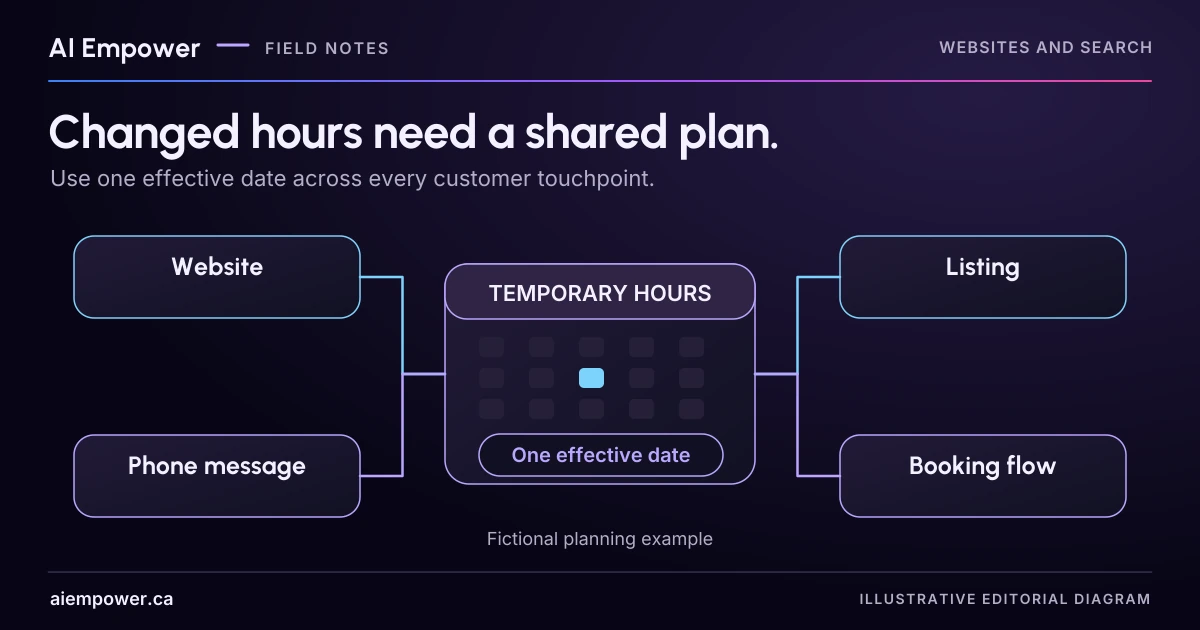
Record the approved temporary hours, every affected channel, a verification owner and the restoration step.
Changing the hours on your contact page is only the start. A customer may see a search profile, hear a voice greeting, read a saved reply or ask a chat assistant. If those places disagree, the customer has to decide which version to trust.
Before a holiday or temporary closure, create one approved exception record and follow it through every relevant customer route. The exercise below uses entirely fictional hours. They are not AI Empower's operating hours, a holiday calendar or a recommendation to close on particular dates.
Define the exception precisely
Imagine a fictional equipment showroom called Cedar Display. Its usual hours are Monday to Friday, 9 a.m. to 5 p.m., in the America/Toronto time zone. Its owner proposes these exceptions:
- 24 December 2026: showroom and staffed phone line open 9 a.m. to noon.
- 25 December 2026: showroom and staffed phone line closed.
- 28 December 2026: usual hours resume, subject to final owner approval.
- The enquiry form remains available, but submissions are not reviewed during the closure.
The last fact matters. A form accepting text does not establish that a person is available to answer. Likewise, a chat interface being online does not mean the showroom is open or that an appointment can be confirmed.
Record the affected location and service beside every exception. If collection, telephone support and the showroom have different hours, they need separate statements. Do not compress them into “We're open” when the customer needs to know which service is operating.
Find the places that repeat the fact
Walk through the routes a customer actually uses. Start with the homepage notice, contact page, location page and any service page that includes hours. Then check external business profiles, appointment instructions, confirmation templates, voicemail or voice-assistant greetings, staff reply templates and the sources used by a chat assistant.
Add a printed sign if people visit in person. Add a booking system only if the business uses one. The purpose is a relevant inventory, not a long checklist filled with platforms your business has never adopted.
For each location, record who can change it and who can verify the public result. “Website team” is too vague if nobody knows which person has access before the break. A channel with no available owner is a risk to resolve while the normal team is still working.
Build a change and restoration record
Use these columns in a working document:
| Customer route | Required message | Change owner | Public check | End-of-exception action |
|---|---|---|---|---|
| Contact page | Date-specific showroom and phone hours | Site editor | Read page as a visitor | Remove expired notice after checking normal hours |
| Enquiry confirmation | Form accepted; review resumes on the approved date | Operations lead | Run authorised fictional test | Restore current ordinary wording |
| Voice greeting | Current closure and supported alternative | Voice administrator | Listen through authorised test route | Verify the new greeting |
| Chat source | Dated exception with location and service scope | FAQ owner | Test questions about each affected date | Retire exception and retest |
Leave status as proposed until the owner has approved the facts. Keep “edited,” “saved” and “publicly verified” separate. A dashboard accepting a change does not establish that every public view has updated.
For a Google Business Profile, Google's current guidance provides special hours for temporary changes and closures of up to six consecutive days. Longer closures need the appropriate alternative in its guidance. Recheck the platform's current instructions before editing; avoid changing the ordinary weekly schedule merely to represent a one-day exception.
Week 11 · Fictional local practice
Follow one exception through every channel
A versioned rehearsal ledger distinguishing saved work from reported public checks.
Use fictional, non-sensitive values only. Entries remain in page memory. No uploads, storage or network requests are made by this activity. Copy and print occur only when selected.
Cedar Display: proposed exception, revision 1
Usual: Monday to Friday, 9 a.m. to 5 p.m., America/Toronto.
- 24 December 2026: showroom and staffed phone line open 9 a.m. to noon.
- 25 December 2026: showroom and staffed phone line closed.
- Proposed usual-hours resumption: 2026-12-28, subject to final owner approval.
- The enquiry form remains available, but submissions are not reviewed during the closure.
Dates and owner approval are fictional. No live account is read or updated. Reopening does not establish a response deadline.
Rehearse a late resumption-date change
Existing channel records keep their old revision so unfinished corrections remain visible. A revised date requires its own owner decision.
Rehearse the customer’s question
Expand your real inventory only with channels actually used: homepage, location/service pages, profiles, booking instructions, reply templates, printed signs and the chat source. A missing owner needs resolving before staff leave.
Take your record with you
Includes all current choices, source limits and unanswered fields. Copy and print happen only when you choose.
Holiday exception channel ledger · local practice v1
Local fictional practice only. No real business facts, outcome, legal compliance, accessibility, search performance or live account state are validated. Entries stay in page memory; no network requests, analytics or persistence. Refresh clears work. Do not enter personal or confidential information.

Cedar Display (fictional)
Proposed revision 1; no real owner approval established.
Simulated approval: not recorded for current revision
Fictional approving-owner role field: Not recorded
Unapplied resumption-date draft: No pending change (does not change the current revision)
America/Toronto; usual Monday to Friday, 9 a.m. to 5 p.m.
24 December 2026: showroom and staffed phone line open 9 a.m. to noon.
25 December 2026: showroom and staffed phone line closed.
Proposed usual-hours resumption: 2026-12-28
The enquiry form remains available, but submissions are not reviewed during the closure.

Contact page
Required message: Date-specific showroom and phone hours
Suggested public check: Read page as a visitor
Owner: Not recorded; verifier: Not recorded
State: proposed; record revision 1; checked revision none
Proposed; no current edit or public check recorded.
Observed public result: Not recorded
Restoration task: Remove expired notice after checking normal hours
Restoration observation: Not recorded

Enquiry confirmation
Required message: Form accepted; review resumes on the approved date
Suggested public check: Run authorised fictional test
Owner: Not recorded; verifier: Not recorded
State: proposed; record revision 1; checked revision none
Proposed; no current edit or public check recorded.
Observed public result: Not recorded
Restoration task: Restore current ordinary wording
Restoration observation: Not recorded

Voice greeting
Required message: Current closure and supported alternative
Suggested public check: Listen through authorised test route
Owner: Not recorded; verifier: Not recorded
State: proposed; record revision 1; checked revision none
Proposed; no current edit or public check recorded.
Observed public result: Not recorded
Restoration task: Verify the new greeting
Restoration observation: Not recorded

Chat source
Required message: Dated exception with location and service scope
Suggested public check: Test questions about each affected date
Owner: Not recorded; verifier: Not recorded
State: proposed; record revision 1; checked revision none
Proposed; no current edit or public check recorded.
Observed public result: Not recorded
Restoration task: Retire exception and retest
Restoration observation: Not recorded

Are you open on 24 December? For the fictional proposed exception, the showroom and staffed phone line are open 9 a.m. to noon on 24 December 2026, America/Toronto. Owner approval is still required.
Can I call in the afternoon? On 24 December 2026 the fictional staffed phone line is closed after noon. An online form does not mean a person is available.
Can I send an enquiry on 25 December? The form remains available, but submissions are not reviewed during the closure. No immediate staff response is established.
Are you open tomorrow? Cannot determine without the current local date. A static excerpt alone cannot settle “tomorrow”.
Will someone reply by Monday morning? No response-time promise is supplied. A reopening date is not a reply deadline.
No real accounts were changed, verified or restored. Current platform guidance and actual route behavior must be reviewed separately.
Use the text-only exercise
The complete unchanged manuscript remains readable if the controls are unavailable.
Return to Build a change and restoration recordRehearse the questions that can go wrong
Ask the fictional content these questions before release:
- “Are you open on 24 December?” The answer needs the shorter hours and the affected service.
- “Can I call in the afternoon?” On that date, the staffed line is closed after noon.
- “Can I send an enquiry on 25 December?” The form remains available, with no implication of immediate staff review.
- “Are you open tomorrow?” The answer depends on the current local date. A static excerpt without date context cannot settle it.
- “Will someone reply by Monday morning?” Nothing in the fictional record creates that promise.
Include the year. A reusable notice saying only “closed on the 25th” can become misleading when encountered later. Use unambiguous written dates, identify the business's time zone where it matters and confirm how each system treats date boundaries. Test before the exception, while it applies and after it ends.
Do not assume an assistant understands effective dates because they appear somewhere in a source file. Check the answer it actually produces. If it cannot distinguish the current arrangement from the future exception, use a verified static notice or staff route until the issue is resolved.
Plan for a late change
Suppose Cedar's fictional owner changes the reopening date after some channels have already been updated. Record a new version of the exception. Mark the old version superseded, list the channels still showing it and assign the correction order based on where customers are most likely to act on the wrong information.
If a platform cannot be updated promptly, explain the limitation through a channel the business controls and can keep accurate. Do not invent an emergency contact or promise a response from absent staff. The alternative must work under the actual staffing arrangement.
When the exception ends, verify the ordinary facts again. Restoring an old screenshot or template may bring back an unrelated stale phone number or service detail. Close the record only after the relevant customer routes agree and each unresolved item has an owner.
Use the table as a manual exercise; its output is a dated list of changes, evidence checks and restoration tasks. If the channel ledger is available on this page, rehearse fictional owner approval and record each channel’s edit, save, public check and restoration. These are practice entries: the activity reads or updates no accounts and verifies no real approval or public display.
Ask AI Empower about keeping your customer information consistent, starting with the channels where your customers look for hours.
Sources & review
Primary sources checked on . The checklists and planning examples are AI-assisted editorial guidance, not source quotations or reported client results.
This AI-assisted guide uses fictional examples for practice. It does not report client results or establish that a live system will behave the same way.
Originally published: .