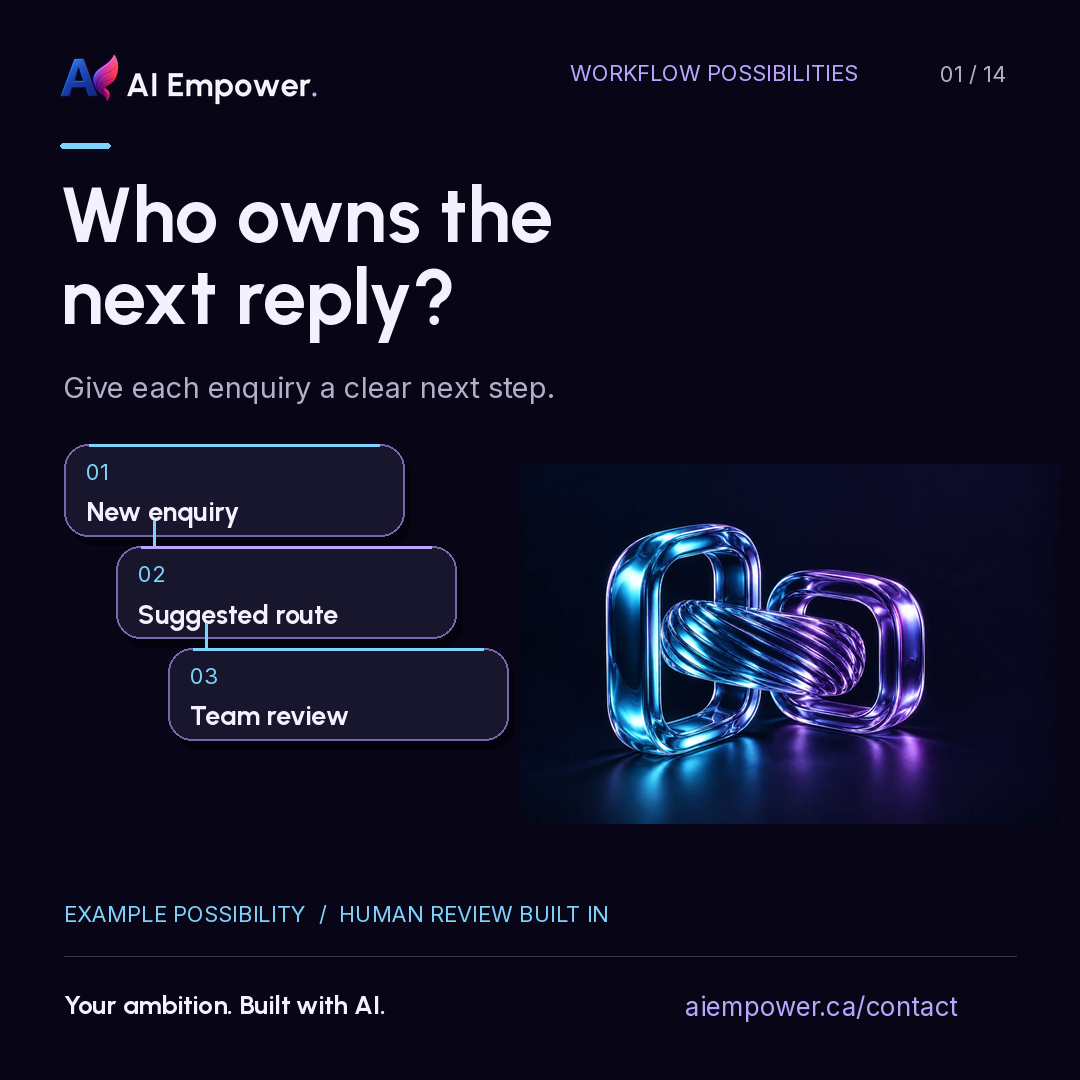
Trace work and waiting separately, name each owner and check whether a proposed improvement merely moves the queue.
Find the delay before choosing a tool
When customers wait for a reply, writing speed is an easy problem to notice. It may not be the step causing the delay. An enquiry can sit unassigned, reach the wrong person, lack an essential detail, or wait for a decision after a draft is already finished.
A small workflow map helps you distinguish those situations before choosing an AI pilot. You can make it with paper or an ordinary document. The goal is to identify one observable bottleneck and decide what evidence would show that a change helped.
Start and finish at meaningful events
Choose one enquiry type, such as a request for information about a business service. Define the beginning as the moment the message reaches the team's agreed intake channel. Define the end as a checked response being sent or the request being handed to a named person with an acknowledged next step.
Do not use “AI produced a reply” as the endpoint if staff still need to locate the source, correct the draft, and decide who should send it. Equally, avoid stretching the map all the way to a sale if the immediate question is why initial replies are delayed.
Keep the scope separate from the choice of channel. The chat-versus-voice guide considers customer channels; this exercise follows ownership and waiting inside the business.
Map what happens, including the loops
Ask the people doing the work to walk through a recent, ordinary example within an approved internal environment. Write down the observed steps: received; checked for missing details; assigned; researched; drafted; reviewed; sent. Add the actual owner and the evidence that shows each step is complete.
Draw the loops too. A reviewer might return a draft because the service guide is unclear. The author might ask a colleague who is away. The customer might provide a missing detail in a second message that never reaches the first reviewer. These loops matter because an ideal sequence can hide the effort your staff experience.
If people disagree about the process, keep both versions visible until you understand the difference. They may be describing distinct enquiry types that should not be forced into one workflow.
Separate working time from waiting time
Record when each step becomes ready, when someone starts it, and when the result is handed on. Working time is the effort spent on the task; waiting time is the interval before the next person or input becomes available. Keep the two concepts separate even if your first observations are approximate.
Use process information rather than copying private message contents into a new tool. The Canadian privacy regulators' generative AI principles encourage using synthetic or de-identified information where personal information is unnecessary. Use fictional examples to practise the trace format; diagnose actual delays from privacy-safe observations of real work.
A hypothetical observation could read: “The draft was ready, but the enquiry remained in the author's queue while they waited for someone to confirm who could approve it.” That suggests an ownership problem to investigate. It does not establish that AI drafting would reduce the customer's wait.
Use a simple enquiry trace
For each safely documented example, record the following fields. Avoid treating the sheet as a new store for customer records.
-
Enquiry type: the question or task category, without identifying the customer
-
Current stage: where the work is now
-
Ready signal: what makes the next step possible
-
Ready timestamp: when the required input and authority were available for this step
-
Start timestamp: when someone actually began working on the step
-
Completion timestamp: when the step finished and its result was handed on
-
Active-work minutes: time spent handling the step, excluding interruptions and waiting
-
Owner: who is expected to act
-
Blocker: missing information, unclear responsibility, unavailable source, review, or another observed cause
-
Next action: one action that would move this example forward
-
Completion evidence: how the team will know that action happened
Hypothetical entry: “Service information; ready for review; draft and approved guide available; operations lead; no backup reviewer defined; assign a backup for this queue; reviewer acknowledges ownership.” This is an invented illustration of the record, not a diagnosis of a real business.
Week 6 · interactive local candidate
Work, wait and the displaced queue
Fictional local exercise. This exercise keeps its working inputs in page memory and starts over on reset or reload. It does not automatically submit or save those inputs, call an AI or access accounts. Copies and printouts are outside reset; browser-managed history, extensions and device behaviour are outside this exercise’s control. Use invented examples only; do not enter personal records or credentials. No real transfers or independent verification are performed.
Receipt is minute 0. Keep the same serial start and end points. Record ready, actual start, completion and active work; a start-to-finish span may contain interruptions. These figures are invented teaching data.
Before trace
Before: 122 minutes elapsed
| Active | Queue | Within-stage non-working | Unassigned gap |
|---|---|---|---|
| 35 | 80 | 7 | 0 |
Candidate trace
Candidate: 122 minutes elapsed
| Active | Queue | Within-stage non-working | Unassigned gap |
|---|---|---|---|
| 35 | 80 | 7 | 0 |
Review pending. Change inputs, then review the current version. Earlier results are cleared after every edit.
Week 6: Work, wait and the displaced queue
Fictional local exercise. This exercise keeps its working inputs in page memory and starts over on reset or reload. It does not automatically submit or save those inputs, call an AI or access accounts. Copies and printouts are outside reset; browser-managed history, extensions and device behaviour are outside this exercise’s control. Use invented examples only; do not enter personal records or credentials. No real transfers or independent verification are performed.
All observations and checks below are fictional or reader-reported; none independently verified.

FIXED FICTIONAL REFERENCE
{
  "job": "Follow a serial enquiry from receipt at minute zero through checked response sent or acknowledged next step.",
  "definitions": {
    "ready": "Input and authority are available.",
    "start": "Work actually begins.",
    "end": "Result is completed and handed onward.",
    "active": "Handling effort excluding interruptions.",
    "queue": "Start minus ready.",
    "withinStageNonWorking": "Completion minus start minus active.",
    "gap": "Ready minus previous completion; initial previous completion is receipt at zero."
  },
  "rules": "Non-negative decimal elapsed minutes with at most two decimals, up to 100000; no overlapping stages; active cannot exceed its span. Similar enquiries and conditions still need real observations."
}

CURRENT INPUTS (fictional / reader-entered)
{
  "before": [
    {
      "stage": "Intake and assignment",
      "ready": "0",
      "start": "15",
      "end": "20",
      "active": "5",
      "owner": "Intake role",
      "blocker": "No visible owner",
      "evidence": "Reviewer acknowledges ownership"
    },
    {
      "stage": "Find source",
      "ready": "20",
      "start": "25",
      "end": "35",
      "active": "8",
      "owner": "Service role",
      "blocker": "Guide location unclear",
      "evidence": "Current guide opened"
    },
    {
      "stage": "Draft",
      "ready": "35",
      "start": "35",
      "end": "45",
      "active": "10",
      "owner": "Drafting role",
      "blocker": "No blocker recorded",
      "evidence": "Draft ready for review"
    },
    {
      "stage": "Review",
      "ready": "45",
      "start": "105",
      "end": "120",
      "active": "10",
      "owner": "Review role",
      "blocker": "No backup reviewer",
      "evidence": "Source check complete"
    },
    {
      "stage": "Send or acknowledged handoff",
      "ready": "120",
      "start": "120",
      "end": "122",
      "active": "2",
      "owner": "Service role",
      "blocker": "No blocker recorded",
      "evidence": "Fictional sent-state record or named owner acknowledgment"
    }
  ],
  "after": [
    {
      "stage": "Intake and assignment",
      "ready": "0",
      "start": "15",
      "end": "20",
      "active": "5",
      "owner": "Intake role",
      "blocker": "No visible owner",
      "evidence": "Reviewer acknowledges ownership"
    },
    {
      "stage": "Find source",
      "ready": "20",
      "start": "25",
      "end": "35",
      "active": "8",
      "owner": "Service role",
      "blocker": "Guide location unclear",
      "evidence": "Current guide opened"
    },
    {
      "stage": "Draft",
      "ready": "35",
      "start": "35",
      "end": "45",
      "active": "10",
      "owner": "Drafting role",
      "blocker": "No blocker recorded",
      "evidence": "Draft ready for review"
    },
    {
      "stage": "Review",
      "ready": "45",
      "start": "105",
      "end": "120",
      "active": "10",
      "owner": "Review role",
      "blocker": "No backup reviewer",
      "evidence": "Source check complete"
    },
    {
      "stage": "Send or acknowledged handoff",
      "ready": "120",
      "start": "120",
      "end": "122",
      "active": "2",
      "owner": "Service role",
      "blocker": "No blocker recorded",
      "evidence": "Fictional sent-state record or named owner acknowledgment"
    }
  ],
  "change": "",
  "owner": "",
  "endpoint": "Checked response sent or named owner acknowledges the next step",
  "conditions": "Invented single-enquiry example; no observed business data."
}

Review pending. No current result; any earlier review was invalidated by input changes.

LIMITATIONS AND WARNINGS
• Filled fields and reader-reported checks are not independent evidence or real business approval.
• Offsets are elapsed minutes from receipt, not staff clock time or dates. This serial trace assumes no parallel stages. Within-stage non-working time and between-stage gaps are kept separate. No savings or capacity forecast.
• Name one reversible change, its owner and a checked completion endpoint.
Use the text-only exercise
The complete unchanged manuscript remains readable if the controls are unavailable.
Return to Use a simple enquiry traceMatch the proposed change to the observed blocker
-
If work waits because no owner is assigned, first test a visible assignment rule and a backup owner.
-
If enquiries repeatedly lack the same necessary detail, examine the intake question or staff clarification template.
-
If people spend effort finding contradictory guidance, resolve the source conflict and identify who maintains the answer.
AI may be worth testing when varied language creates a specific preparation task, such as summarising a long enquiry for staff. Keep the original message accessible in the authorised system so the employee can check the summary. The proposed benefit should be connected to the work you observed, not simply to how impressive the generated text looks.
Some bottlenecks concern capacity or a business decision. No drafting tool can decide an unresolved service policy on the team's behalf. Record that decision separately rather than asking the software to make assumptions.
Check whether the queue moved somewhere else
After a small change, repeat the trace through the same start and end points. Look for displaced work: faster drafting followed by a growing review queue, cleaner intake followed by more abandoned forms, or quicker assignment followed by repeated reassignment.
Compare similar enquiry types and note unusual conditions such as staff absence or a temporary campaign. A small sample can reveal a failure worth fixing, but it cannot establish a dependable forecast for every future customer.
Ask the staff doing the review whether the change reduced their effort or merely changed its shape. Keep the original process available while you evaluate a reversible trial.
Turn the map into one practical next step
Write a short decision statement: “We observed this delay at this stage. We will change this one step. This person owns the trial. We will check the enquiry through to this completion event.” Leave projected savings blank until you have evidence.
If that statement is still difficult to write, spend another session observing the work. If it is clear, the map becomes a useful starting point for an AI consultancy discussion, a process improvement, or a decision to leave a working step alone.
Sources rechecked 4 October 2026
Sources & review
Primary sources checked on . The checklists and planning examples are AI-assisted editorial guidance, not source quotations or reported client results.
This AI-assisted guide uses fictional examples for practice. It does not report client results or establish that a live system will behave the same way.
Originally published: .