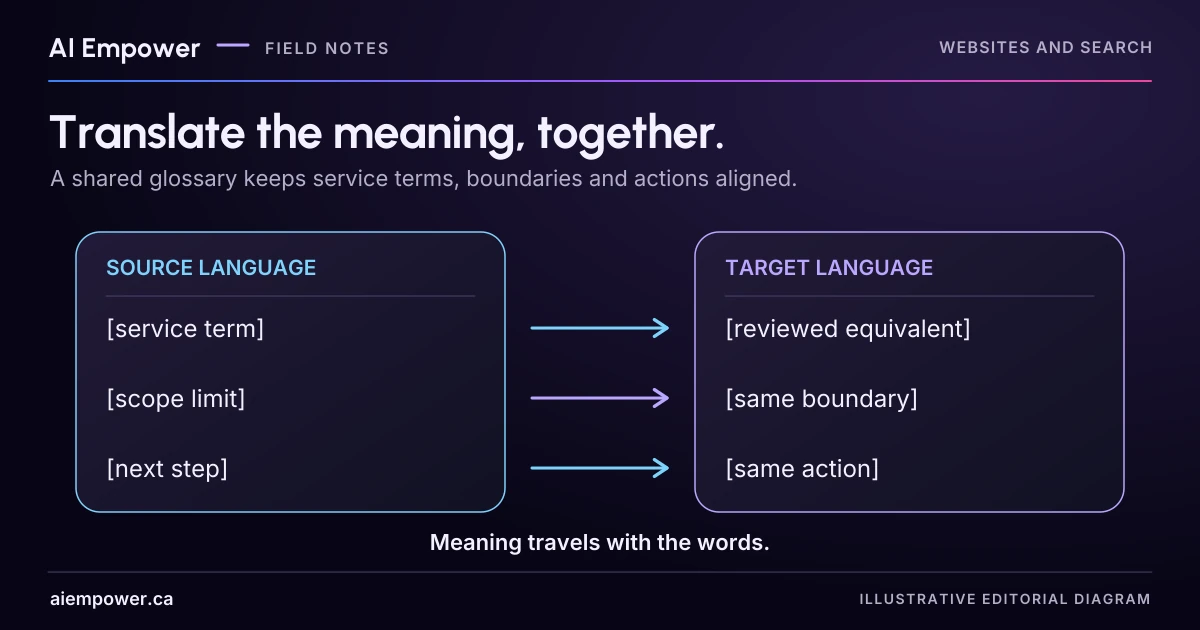
Record the intended meaning of service terms, resolve uncertain promises and assign a target-language review before publishing a translation.
A service page uses “review,” “assessment” and “consultation” as if they mean the same thing. A translator has to decide whether they describe one service or three. AI can produce fluent wording while leaving that business question unresolved.
Before translating the page, make a small glossary of the concepts that affect a customer’s decision. Define what each term means in this business, where it appears and what it must not imply. Then give a qualified target-language reviewer enough context to choose suitable wording.
This article uses an invented website-support service. It does not provide a certified translation or advice on legal, medical or other regulated text. The output is a reviewable glossary and a queue of decisions, not a finished multilingual page.
Start with the customer’s decision
Imagine the fictional service offers a “website review.” The owner means a scheduled review of three agreed pages, followed by written findings. It does not include fixing the site, formal accessibility certification or an ongoing support subscription.
Those boundaries need to travel with the term. A word that sounds natural in another language but implies a formal certification would change the offer. A phrase that implies unlimited pages would also change it, even if every sentence reads smoothly.
Write the core meaning in plain source-language text before requesting a translation:
“An agreed review of three named website pages. The customer receives written findings. Implementation is a separate, separately agreed service.”
Have the business owner check that statement against the real offer before using this method on an actual page. The invented description is not a description of an AI Empower package.
Build meaning cards
Use one card per important term. A spreadsheet is optional; a short shared document can be enough.
| Term | Approved meaning in this fictional service | Must not imply | Target wording |
|---|---|---|---|
| Website review | Review of three agreed pages with written findings | Certification or automatic repairs | Awaiting reviewer |
| Findings | Observations and suggested next steps | A guaranteed outcome | Awaiting reviewer |
| Implementation | Separately agreed work to make changes | Included in the review | Awaiting reviewer |
| Working day | A day under the business’s defined service calendar | Every calendar day | Definition unresolved |
For each card, add a sentence from the page, the intended audience and locale, any approved brand spelling, the owner of the meaning and the reviewer of the translation. “French” or “Spanish” alone may not tell the reviewer enough about the audience and local usage.
The Google style guide for global audiences recommends consistent terminology to avoid ambiguity and mistranslation. A glossary makes that consistency reviewable. It cannot resolve an offer the business itself has not defined.
Do not translate an unresolved promise
The “working day” entry remains unresolved on purpose. Suppose the draft says findings arrive “within five working days,” but the team has not agreed when that period starts or which calendar applies. Translating the sentence accurately would preserve an ambiguous promise.
Put it in the decision queue: “Owner must define the start event, service calendar and actual commitment before translation.” Keep it out of the approved-claim column until resolved. Do the same for prices, inclusions, availability, qualifications and support limits.
AI can help extract repeated terms or propose questions for the reviewer. Use approved, non-sensitive page text and an authorised tool. Treat proposed definitions as suggestions. A model should not invent a commercial meaning because the glossary has an empty cell.
Compare the claims in both directions
After a target-language draft is available, ask the reviewer to explain what a customer would understand, in their own words. Check the practical questions:
- What is included, and what needs a separate agreement?
- What must the customer provide before work begins?
- Which quantities, dates, prices and limits appear?
- What does the button lead to: an enquiry, a purchase or a confirmed booking?
- What is uncertain or conditional?
A reverse translation can expose differences, but it is another text to review. Do not treat a machine round trip as proof of correctness. Keep the source claim, target passage and reviewer’s decision together so a later edit can be traced.
Week 36 · interactive local candidate
Carry the business meaning into translation
Fictional local exercise. This exercise keeps its working inputs in page memory and starts over on reset or reload. It does not automatically submit or save those inputs, call an AI or access accounts. Copies and printouts are outside reset; browser-managed history, extensions and device behaviour are outside this exercise’s control. Use invented examples only; do not enter personal records or credentials. No real transfers or independent verification are performed.
Draft four meaning cards for an invented website-support service. Supply candidate target wording only if you can review it responsibly. No machine translation or approval is performed here.
Review pending. Change inputs, then review the current version. Earlier results are cleared after every edit.
Week 36: Carry the business meaning into translation
Fictional local exercise. This exercise keeps its working inputs in page memory and starts over on reset or reload. It does not automatically submit or save those inputs, call an AI or access accounts. Copies and printouts are outside reset; browser-managed history, extensions and device behaviour are outside this exercise’s control. Use invented examples only; do not enter personal records or credentials. No real transfers or independent verification are performed.
All observations and checks below are fictional or reader-reported; none independently verified.

FIXED FICTIONAL EXERCISE CONTEXT
{
  "terms": [
    {
      "term": "Website review",
      "meaning": "Review of three agreed pages with written findings.",
      "excludes": "Certification or automatic repairs",
      "sentence": "Ask about a review of three agreed pages."
    },
    {
      "term": "Findings",
      "meaning": "Observations and suggested next steps.",
      "excludes": "A guaranteed outcome",
      "sentence": "The customer receives written findings."
    },
    {
      "term": "Implementation",
      "meaning": "Separately agreed work to make changes.",
      "excludes": "Included in the review",
      "sentence": "Implementation is a separate service."
    },
    {
      "term": "Working day",
      "meaning": "Definition unresolved.",
      "excludes": "Every calendar day",
      "sentence": "Findings arrive within five working days. This promise is unresolved."
    }
  ],
  "workingDay": "Owner-defined meaning, start event, service calendar and actual commitment are required; wording and approvals are not independently verified."
}

CURRENT INPUTS (fictional / reader-entered)
{
  "locale": "",
  "audience": "Fictional small-business website owner deciding whether to enquire.",
  "version": "Fictional service page v1",
  "startEvent": "",
  "calendar": "",
  "commitment": "",
  "rows": [
    {
      "term": "Website review",
      "meaning": "Review of three agreed pages with written findings.",
      "excludes": "Certification or automatic repairs",
      "sentence": "Ask about a review of three agreed pages.",
      "target": "",
      "explanation": "",
      "owner": "Fictional service owner",
      "reviewer": "",
      "reviewed": false
    },
    {
      "term": "Findings",
      "meaning": "Observations and suggested next steps.",
      "excludes": "A guaranteed outcome",
      "sentence": "The customer receives written findings.",
      "target": "",
      "explanation": "",
      "owner": "Fictional service owner",
      "reviewer": "",
      "reviewed": false
    },
    {
      "term": "Implementation",
      "meaning": "Separately agreed work to make changes.",
      "excludes": "Included in the review",
      "sentence": "Implementation is a separate service.",
      "target": "",
      "explanation": "",
      "owner": "Fictional service owner",
      "reviewer": "",
      "reviewed": false
    },
    {
      "term": "Working day",
      "meaning": "Definition unresolved.",
      "excludes": "Every calendar day",
      "sentence": "Findings arrive within five working days. This promise is unresolved.",
      "target": "",
      "explanation": "",
      "owner": "Fictional service owner",
      "reviewer": "",
      "reviewed": false
    }
  ]
}

Review pending. No current result; any earlier review was invalidated by input changes.

LIMITATIONS AND WARNINGS
• No translation is generated or semantically certified. A checked review flag records your report only.
• Working day remains held unless start event, service calendar and actual commitment are all defined. Entered definitions still need business approval.
• Source/locale/context edits invalidate review flags. Target drafts are retained as candidates needing re-review.
• Review language metadata, corresponding-page switching, forms, alt text and expanded layout separately in the actual implementation.
Use the text-only exercise
The complete unchanged manuscript remains readable if the controls are unavailable.
Return to Compare the claims in both directionsTest the page, not just the paragraphs
Language changes affect navigation labels, error messages, forms, image alternatives and the language switcher. Check that a visitor stays with the corresponding service when switching languages instead of being unexpectedly returned to the homepage.
Have the implementer set the page’s actual language appropriately. W3C’s Language of Page guidance explains its importance for technologies such as speech synthesis. Also review mixed-language passages, text expansion and layouts with the intended audience. A screenshot that fits at one width is not a multilingual usability test.
Leave a small maintenance trail
Your finished pack should contain the approved source page version, glossary, target-language draft, unresolved decisions and named reviewers. When a service changes, identify every translated claim affected by the change. Avoid updating the source-language price while leaving a different promise elsewhere.
Start with one page and the terms that affect buying or enquiring. A concise, well-reviewed glossary is easier to maintain than a large list of dictionary equivalents with no business context.
Discuss a clear multilingual website structure with AI Empower.
Primary sources checked 4 October 2026
Sources & review
Primary sources checked on . The checklists and planning examples are AI-assisted editorial guidance, not source quotations or reported client results.
This AI-assisted guide uses fictional examples for practice. It does not report client results or establish that a live system will behave the same way.
Originally published: .