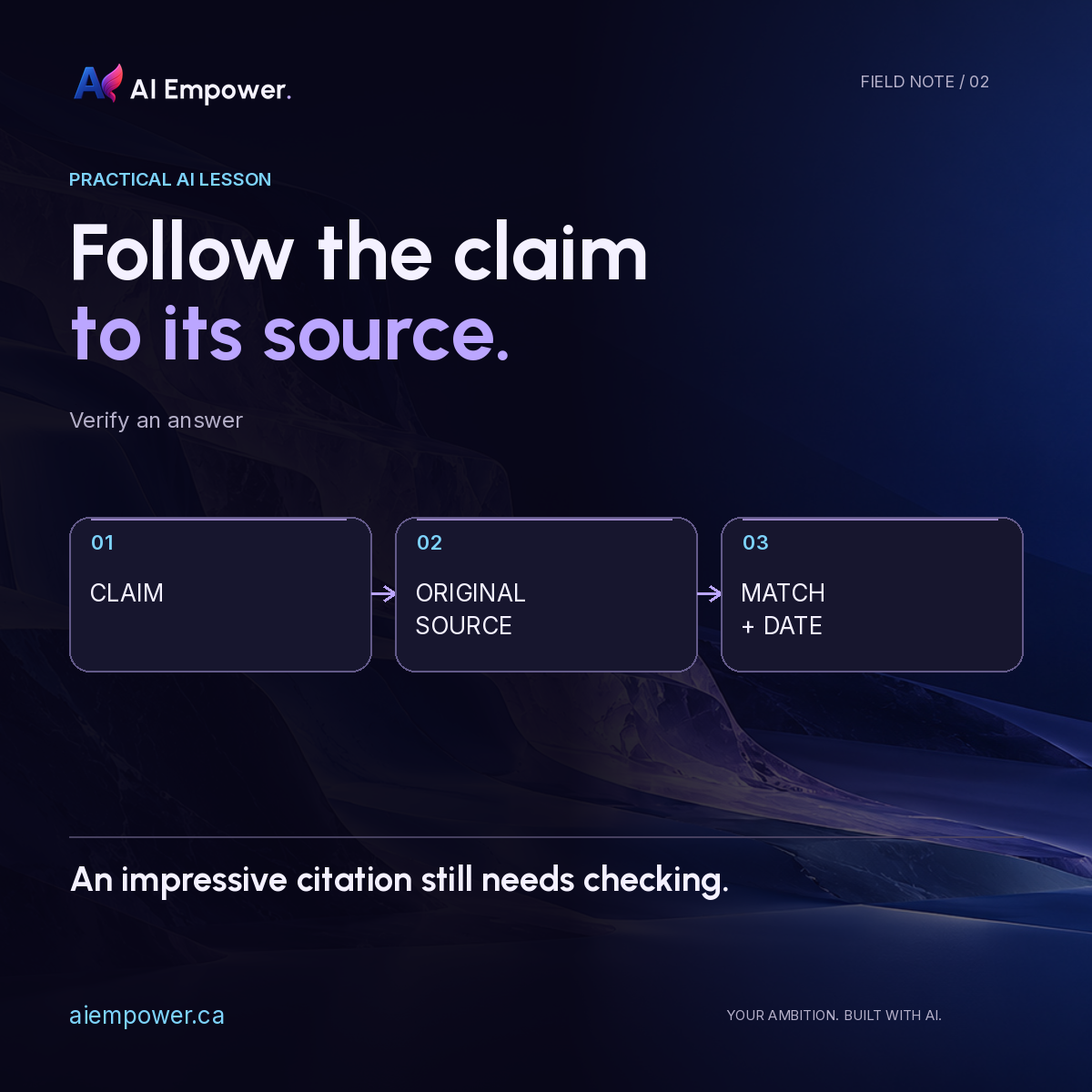
Ask a supplier to demonstrate sources, missing-answer behaviour, permissions and recovery, then record what your own team can verify.
Make the meeting useful
An AI supplier demonstration can look convincing while leaving the everyday work unexplained. The answer arrives quickly, the screen looks tidy, and the presenter knows exactly what to ask. A small business still needs to know what its own staff will see when a request is incomplete, a source changes, or somebody needs to take over.
Use the meeting to collect evidence about one workflow. The questions below are an original discussion guide for a staff-reviewed enquiry-drafting pilot. They are not a vendor rating, certification checklist, or substitute for an appropriate security review.
Prepare a small demo brief
Send the supplier a plain-language task description and a few fictional enquiries. Include an ordinary request, an ambiguous one, and one that cannot be answered from the supplied information. Provide a short, approved source document. Do not send customer records merely to make the demonstration feel realistic.
State the boundary: the system may prepare a reply for staff; it may not send, book, quote, or change customer records. Ask the supplier to distinguish what is working in the demonstration from a mock-up, a planned feature, or an integration that still needs building. Record these distinctions beside the relevant screen.
If the workflow itself is undecided, use the first AI project guide before booking a product comparison. Otherwise, use the questions below to investigate the specific proposal.
1. Can we follow an answer back to the exact evidence?
Ask the supplier to open the source supporting a factual sentence. Then check whether that passage supports the whole claim, including exceptions and conditions. A link to a long document leaves considerable review work with your employee.
Hypothetical example: a guide says on-site service is available after the team confirms the location. A draft that says “We can visit your site” has removed a condition. Ask how the reviewer sees both the original condition and the proposed wording. Record the answer with a screenshot or written observation, subject to the supplier's sharing permissions.
2. What does the employee see when evidence is missing?
Remove the answer from the fictional source pack and repeat the question. Does the result identify the missing fact, ask for clarification, or quietly fill the gap? Ask who receives unresolved work and how that person notices it.
A useful demonstration lets your employee make the next decision. A vague uncertainty disclaimer at the bottom of a confident answer gives them less help. Ask for the exact output the reviewer would receive, rather than accepting a general statement that a human remains involved.
3. Which permissions does this version actually need?
Ask for a simple data-flow explanation: what information enters, which services receive it, where results are stored, and which actions the system can perform. Separate a proposed permission from one already required by the demonstrated task.
For a draft-only pilot, question requests for unrelated write access. Ask the supplier to show the relevant configuration or current documentation. Do not infer that a feature is safely restricted because the presenter chose not to click it. Any later expansion of access deserves its own review.
4. Can the reviewer reject the draft without losing the enquiry?
Have an employee reject an intentionally poor answer. Follow the original enquiry to its next state. It should remain visible to whoever owns the work, with an honest indication that no reply has been sent.
Ask what happens if the employee closes the page, another colleague opens the same request, or the draft cannot be generated. This question evaluates recovery and ownership. It does not require the supplier to promise uninterrupted service or to add automatic sending to the scope.
5. How will we tell what changed between two tests?
Ask how a reviewer can identify the source version, task instructions, relevant settings, and software or model version used for a test, where that information is available. When a component's exact version cannot be pinned or exposed, ask the supplier to document that limit and propose a retesting approach.
Avoid interpreting a successful demonstration as evidence that future updates will behave identically. You need a way to investigate a changed answer and decide whether staff should continue using the pilot.
6. What evidence comes with a privacy or security claim?
Ask for current documents describing the specific service tier and configuration being proposed. Questions can cover retention, deletion, training use, subprocessors, access controls, and the handling of support requests. Write unresolved points down for the person qualified to assess them.
The Canadian Centre for Cyber Security recommends reviewing vendors' data-security practices and checking AI outputs against credible sources. This meeting guide does not establish compliance.
If documentation is unavailable during the demo, mark the issue pending. A reassuring answer is still a claim until the supporting material can be checked.
7. Can our team run the next demonstration?
Request a supervised trial in which a staff member uses an approved fictional example the presenter has not rehearsed. Keep the same task boundary. Watch where the employee needs help, which facts they check, and whether the final draft is genuinely easier to review.
The supplier may reasonably need setup time. Agree what can be tested now and what needs a later environment. Do not award a capability a pass because it appears on a roadmap.
Leave with an evidence record and one decision
For each important requirement, keep five fields: claim; evidence observed; unresolved question; responsible person; next decision. Useful evidence labels are “demonstrated,” “document supplied,” “claimed only,” and “not tested.” They prevent an attractive interface from turning every unknown into a yes.
Evidence record to complete during the demonstration
| Field | Your record |
|---|---|
| Claim | ________________ |
| Evidence observed | ________________ |
| Unresolved question | ________________ |
| Responsible person | ________________ |
| Next decision | ________________ |
Hypothetical record: “Draft preserves service-area condition; demonstrated against fictional guide version A; exceptions in longer documents not tested; operations lead to supply another safe example; continue evaluation, no rollout decision.” This is a model entry, not a report of a completed test.
Finally, ask your team which result would make you stop. That is a business decision the supplier cannot make for you. Bring the completed evidence record to an AI consultancy discussion so the next conversation starts with demonstrated needs and clearly labelled gaps.
Week 9 · interactive local candidate
Ask for evidence, keep the gaps
Fictional local exercise. This exercise keeps its working inputs in page memory and starts over on reset or reload. It does not automatically submit or save those inputs, call an AI or access accounts. Copies and printouts are outside reset; browser-managed history, extensions and device behaviour are outside this exercise’s control. Use invented examples only; do not enter personal records or credentials. No real transfers or independent verification are performed.
Seven different questions for one draft-only workflow. Capture what was shown, supplied, merely claimed or left untested. Recording a simulated observation does not validate the supplier.
Review pending. Change inputs, then review the current version. Earlier results are cleared after every edit.
Week 9: Ask for evidence, keep the gaps
Fictional local exercise. This exercise keeps its working inputs in page memory and starts over on reset or reload. It does not automatically submit or save those inputs, call an AI or access accounts. Copies and printouts are outside reset; browser-managed history, extensions and device behaviour are outside this exercise’s control. Use invented examples only; do not enter personal records or credentials. No real transfers or independent verification are performed.
All observations and checks below are fictional or reader-reported; none independently verified.

FIXED FICTIONAL REFERENCE
{
  "job": "Seven questions for a staff-reviewed draft-only demo. No sending, booking, quoting or record changes.",
  "labels": [
    "demonstrated",
    "document supplied",
    "claimed only",
    "not tested"
  ],
  "separation": "Working demonstration, mock-up, planned feature and integration needed remain distinct. No score or certification."
}

CURRENT INPUTS (fictional / reader-entered)
{
  "context": "Fictional staff-reviewed enquiry drafting demonstration; no send, book, quote or record changes.",
  "version": "GUIDE-A v1 / imaginary demo build A",
  "stop": "Stop evaluation if the workflow sends a reply without staff authority.",
  "rows": [
    {
      "claim": "Can a reviewer open the precise passage and see its conditions?",
      "label": "not tested",
      "implementation": "unknown",
      "evidence": "",
      "unresolved": "Ask about on-site service after location confirmation.",
      "owner": "",
      "next": "",
      "recorded": false
    },
    {
      "claim": "What happens when the required fact is removed?",
      "label": "not tested",
      "implementation": "unknown",
      "evidence": "",
      "unresolved": "Remove Saturday hours from the fictional source.",
      "owner": "",
      "next": "",
      "recorded": false
    },
    {
      "claim": "Which permissions does this demonstrated version need?",
      "label": "not tested",
      "implementation": "unknown",
      "evidence": "",
      "unresolved": "Inspect draft-only data flow and question unrelated write access.",
      "owner": "",
      "next": "",
      "recorded": false
    },
    {
      "claim": "Can staff reject a draft without losing the original enquiry?",
      "label": "not tested",
      "implementation": "unknown",
      "evidence": "",
      "unresolved": "Reject a poor draft, close the view, and identify the owner and unsent state.",
      "owner": "",
      "next": "",
      "recorded": false
    },
    {
      "claim": "Which source, instruction, settings and model versions can be identified?",
      "label": "not tested",
      "implementation": "unknown",
      "evidence": "",
      "unresolved": "Compare two tests; document anything that cannot be pinned.",
      "owner": "",
      "next": "",
      "recorded": false
    },
    {
      "claim": "What current documents support this tier and configuration?",
      "label": "not tested",
      "implementation": "unknown",
      "evidence": "",
      "unresolved": "Record retention, deletion, training use, subprocessors and access-control questions for qualified review.",
      "owner": "",
      "next": "",
      "recorded": false
    },
    {
      "claim": "Can a staff member run an unrehearsed fictional case?",
      "label": "not tested",
      "implementation": "unknown",
      "evidence": "",
      "unresolved": "Keep the same draft-only boundary and record assistance.",
      "owner": "",
      "next": "",
      "recorded": false
    }
  ],
  "questions": [
    [
      "Exact evidence",
      "Can a reviewer open the precise passage and see its conditions?",
      "Ask about on-site service after location confirmation."
    ],
    [
      "Missing answer",
      "What happens when the required fact is removed?",
      "Remove Saturday hours from the fictional source."
    ],
    [
      "Permissions",
      "Which permissions does this demonstrated version need?",
      "Inspect draft-only data flow and question unrelated write access."
    ],
    [
      "Reject and recover",
      "Can staff reject a draft without losing the original enquiry?",
      "Reject a poor draft, close the view, and identify the owner and unsent state."
    ],
    [
      "Version changes",
      "Which source, instruction, settings and model versions can be identified?",
      "Compare two tests; document anything that cannot be pinned."
    ],
    [
      "Security claim evidence",
      "What current documents support this tier and configuration?",
      "Record retention, deletion, training use, subprocessors and access-control questions for qualified review."
    ],
    [
      "Staff-led trial",
      "Can a staff member run an unrehearsed fictional case?",
      "Keep the same draft-only boundary and record assistance."
    ]
  ]
}

Review pending. No current result; any earlier review was invalidated by input changes.

LIMITATIONS AND WARNINGS
• Filled fields and reader-reported checks are not independent evidence or real business approval.
• Evidence categories describe this fictional record only. A document is not a demonstrated workflow, a mock-up or roadmap is not working capability, and this board is not a supplier ranking or security certification.
• Exact evidence: record incomplete or changed; carry this question forward.
• Exact evidence: capability remains unestablished.
• Missing answer: record incomplete or changed; carry this question forward.
• Missing answer: capability remains unestablished.
• Permissions: record incomplete or changed; carry this question forward.
• Permissions: capability remains unestablished.
• Reject and recover: record incomplete or changed; carry this question forward.
• Reject and recover: capability remains unestablished.
• Version changes: record incomplete or changed; carry this question forward.
• Version changes: capability remains unestablished.
• Security claim evidence: record incomplete or changed; carry this question forward.
• Security claim evidence: capability remains unestablished.
• Staff-led trial: record incomplete or changed; carry this question forward.
• Staff-led trial: capability remains unestablished.
Use the text-only exercise
The complete unchanged manuscript remains readable if the controls are unavailable.
Return to Leave with an evidence record and one decisionSources rechecked 4 October 2026
Sources & review
Primary sources checked on . The checklists and planning examples are AI-assisted editorial guidance, not source quotations or reported client results.
This AI-assisted guide uses fictional examples for practice. It does not report client results or establish that a live system will behave the same way.
Originally published: .