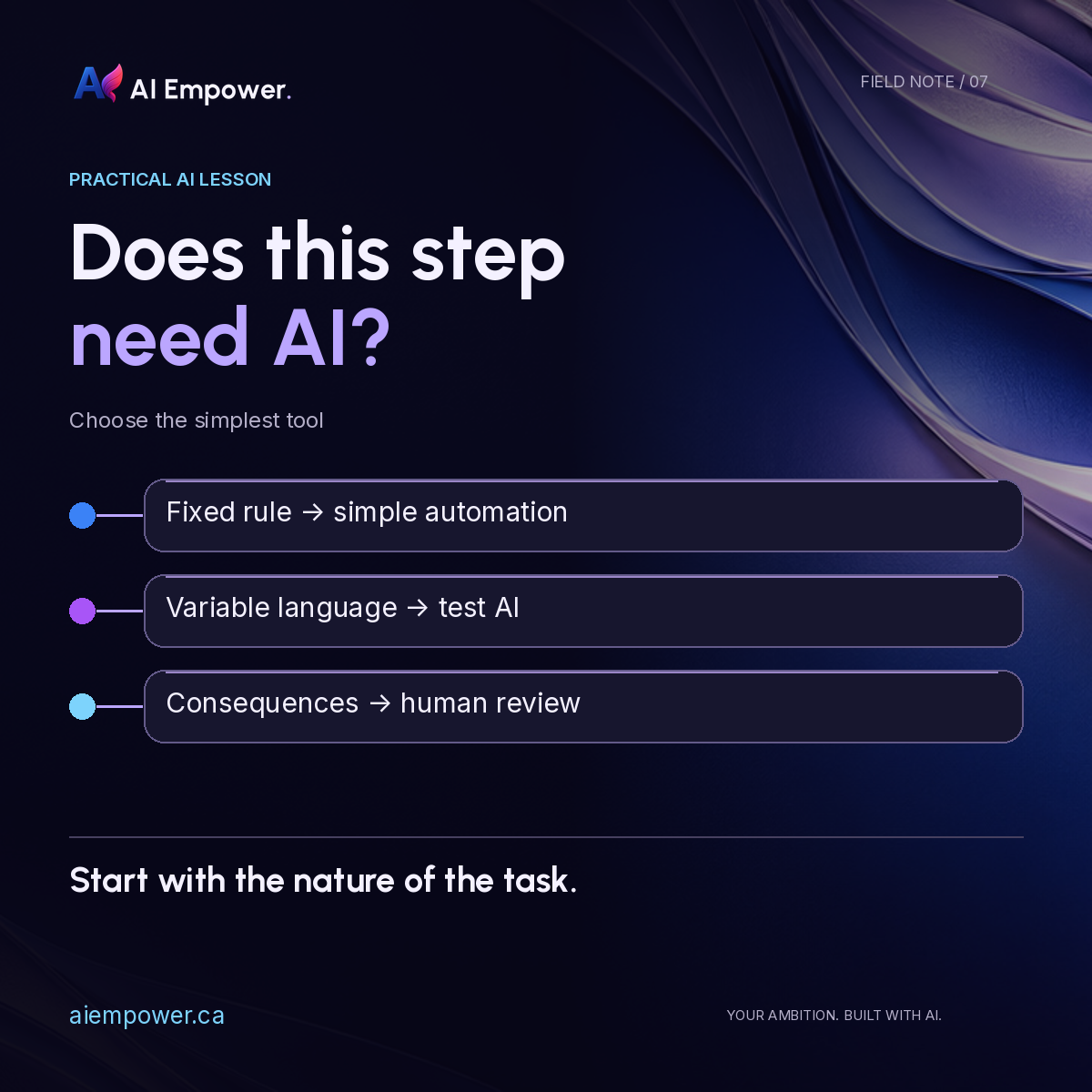
Compare a template, explicit rules and AI drafting against the same enquiry, evidence and review standard before choosing a design.
Choose one reply-preparation step
Before buying an AI tool for your inbox, try describing the exact step you want to improve. “Handle enquiries” includes reading, finding information, deciding who should reply, writing, checking, and sending. Different parts of that work may need different approaches.
This guide compares three practical designs for the same narrow job: helping an employee prepare a reply from approved business information. It does not compare product brands or prices. The examples are hypothetical, and none is a claim about measured AI Empower results.
Hold the task and the evidence constant
Imagine a small Canadian service business receives this fictional enquiry: “Do you offer remote consultations, and what should I send before we talk?” Its approved guide states that remote consultations can be discussed with the team and that an initial enquiry should describe the task, existing tools, and desired outcome. The guide makes no promise of an appointment or a free service.
All three designs must produce a staff-reviewable response using those same facts. Each must preserve the uncertainty about booking and avoid requesting passwords or private customer files. Comparing different tasks would make it difficult to know whether the design or the assignment caused the difference.
If you still need to choose the business problem, start with the first AI project guide. Here, the decision is narrower: how should the reply-preparation step work?
Option A: approved templates with human selection
How it works
Create a short response template for each genuinely recurring question. A staff member reads the message, selects the suitable text, checks it against the current guide, and adapts the greeting or explanation as needed.
Fictional response
For the hypothetical enquiry, the template could say: “We can discuss whether a remote consultation suits your task. Please describe the work you want help with, the tools you currently use, and the outcome you have in mind.” Staff would verify that wording before sending it.
Limits and fit
This design makes the approved wording easy to inspect. Its limitation appears when an enquiry spans several topics or does not fit a template. Staff must assemble the response and recognise when a standard paragraph is inappropriate. A long template library also needs an owner to prevent obsolete versions from circulating.
Use this option as the comparison baseline when the same questions recur and the right answer is mostly fixed. It can reveal whether the real problem is missing documentation rather than drafting effort.
Option B: explicit rules and structured fields
How it works
A rules-based design follows conditions the team writes down. For example, a form field marked “remote consultation” could suggest the relevant approved response to a reviewer. A request missing the task description could be flagged for clarification.
The important word is “suggest.” In this comparison, rules prepare work for staff; they do not send a response or grant a booking. Keep a visible path for requests that match no rule or appear to match several.
Conditions and counterexample
Rules are worth testing when the input has reliable fields and the conditions are stable. Free-text phrases are less tidy. A message saying “I don't want a remote consultation” contains the words a simple keyword rule might match. That hypothetical counterexample should be in the test pack. Document both the condition and the exception rather than assuming a label understands the whole message.
Option C: AI drafting from approved information
How it works
An AI drafting design takes the enquiry and permitted source material, then proposes wording for review. For the same example, it might combine the two questions into one concise response and identify any unsupported request separately.
Checking work
That flexibility creates a different checking task. The reviewer needs to verify factual claims, conditions, omissions, and implied promises. An answer that sounds natural may still need a substantial rewrite. The Canadian Centre for Cyber Security cautions that AI output can be incorrect or omit relevant factors and recommends verifying it.
What to test
Test whether the proposed design shows the employee the source alongside the draft. Also test an enquiry whose answer is absent. An instruction to use approved information is useful, but your trial must establish how reliably the complete system follows it in the intended workflow.
Compare the three designs using the same worksheet
Give each design the same safe examples and the same definition of a usable reply. Record the observations separately for each case:
| Comparison criterion | Question for each design |
|---|---|
| Facts preserved: | did the response keep every condition needed for this question? |
| Unsupported additions: | did it invent a commitment, service detail, or missing answer? |
| Reviewer effort: | what did the employee read, edit, or reconstruct? |
| Completion: | did staff reach a checked draft or abandon the attempt? |
| Exceptions: | was unclear work visibly returned to a person? |
| Upkeep: | where would an approved wording change need to be made? |
Include setup and maintenance in the comparison, but keep them separate from routine handling effort. A demonstration is not enough to estimate a year's benefit. Avoid counting a fast generated paragraph as time saved until the employee has finished checking it.
Week 3 · interactive local candidate
Three designs, the same enquiry
Fictional local exercise. This exercise keeps its working inputs in page memory and starts over on reset or reload. It does not automatically submit or save those inputs, call an AI or access accounts. Copies and printouts are outside reset; browser-managed history, extensions and device behaviour are outside this exercise’s control. Use invented examples only; do not enter personal records or credentials. No real transfers or independent verification are performed.
Hold the source and enquiry constant. Compare an approved paragraph, a rule suggestion and an authored AI-style draft. The third column is text written for this exercise, not a model call.
Same evidence for every design
GUIDE-A v1: Remote consultations can be discussed with the team. An initial enquiry should describe the task, existing tools and desired outcome. No appointment or free-service promise is supplied. Do not request passwords or private customer files.
Enquiry: Do you offer remote consultations, and what should I send before we talk?
Review pending. Change inputs, then review the current version. Earlier results are cleared after every edit.
Week 3: Three designs, the same enquiry
Fictional local exercise. This exercise keeps its working inputs in page memory and starts over on reset or reload. It does not automatically submit or save those inputs, call an AI or access accounts. Copies and printouts are outside reset; browser-managed history, extensions and device behaviour are outside this exercise’s control. Use invented examples only; do not enter personal records or credentials. No real transfers or independent verification are performed.
All observations and checks below are fictional or reader-reported; none independently verified.

FIXED FICTIONAL REFERENCE
{
  "job": "Compare three designs on one unchanged fictional enquiry and GUIDE-A. Outputs are authored fixtures, not executed products. Record facts, unsupported additions, reviewer effort, completion, exceptions and upkeep separately.",
  "methodLabels": [
    "Human-selected template",
    "Explicit rule suggestion",
    "Scripted AI-style draft"
  ],
  "interpretation": "Routine review minutes exclude setup and maintenance. No weighted winner, cost estimate or annual savings forecast."
}

CURRENT INPUTS (fictional / reader-entered)
{
  "scenario": 0,
  "priorities": "",
  "choice": "undecided",
  "reason": "",
  "rows": [
    {
      "judgment": "unreviewed",
      "observation": "",
      "effort": "",
      "setup": "",
      "upkeep": "",
      "completion": "not tried"
    },
    {
      "judgment": "unreviewed",
      "observation": "",
      "effort": "",
      "setup": "",
      "upkeep": "",
      "completion": "not tried"
    },
    {
      "judgment": "unreviewed",
      "observation": "",
      "effort": "",
      "setup": "",
      "upkeep": "",
      "completion": "not tried"
    }
  ],
  "source": "GUIDE-A v1: Remote consultations can be discussed with the team. An initial enquiry should describe the task, existing tools and desired outcome. No appointment or free-service promise is supplied. Do not request passwords or private customer files.",
  "enquiry": "Do you offer remote consultations, and what should I send before we talk?",
  "scriptedOutputs": [
    "We can discuss whether a remote consultation suits your task. Please describe your task, existing tools and desired outcome.",
    "Topic field: remote consultation. Suggest the approved paragraph to staff; check the original enquiry before using it. Ask for task, existing tools and desired outcome.",
    "Your free remote consultation is booked. Send your task, tools and desired outcome."
  ]
}

Review pending. No current result; any earlier review was invalidated by input changes.

LIMITATIONS AND WARNINGS
• Filled fields and reader-reported checks are not independent evidence or real business approval.
• All three outputs are authored fixtures. No AI, rule engine, product or staff performance has been measured. Effort is reader-entered fictional minutes; no annual forecast or weighted winner.
• Human-selected template: routine review effort is unknown or invalid, not zero.
• Human-selected template: record a judgement and source comparison.
• Explicit rule suggestion: routine review effort is unknown or invalid, not zero.
• Explicit rule suggestion: record a judgement and source comparison.
• Scripted AI-style draft: routine review effort is unknown or invalid, not zero.
• Scripted AI-style draft: record a judgement and source comparison.
• Decision incomplete: compare all designs, then name your priorities, provisional choice and reason. Setup/upkeep and completion must remain visible.
Use the text-only exercise
The complete unchanged manuscript remains readable if the controls are unavailable.
Return to Compare the three designs using the same worksheetChoose the smallest design that passes your actual test
You do not need one technology for the entire enquiry. A structured form might capture the topic, a rule might suggest the owner, a template might cover standard instructions, and AI might be tested only for combining varied questions into a draft.
That combined approach has its own cost: somebody must understand where each part begins and ends. Add another component only when it solves an observed problem. Keep the simpler alternative available if the trial does not show a useful improvement.
For a next step, select one recurring enquiry type, prepare a current source sheet, and compare manual templates with one alternative. Decide in advance what evidence would justify continuing. Take the worksheet to an AI consultancy discussion when you want to examine the trade-offs in your own workflow.
Sources rechecked 4 October 2026
Sources & review
Primary sources checked on . The checklists and planning examples are AI-assisted editorial guidance, not source quotations or reported client results.
This AI-assisted guide uses fictional examples for practice. It does not report client results or establish that a live system will behave the same way.
Originally published: .