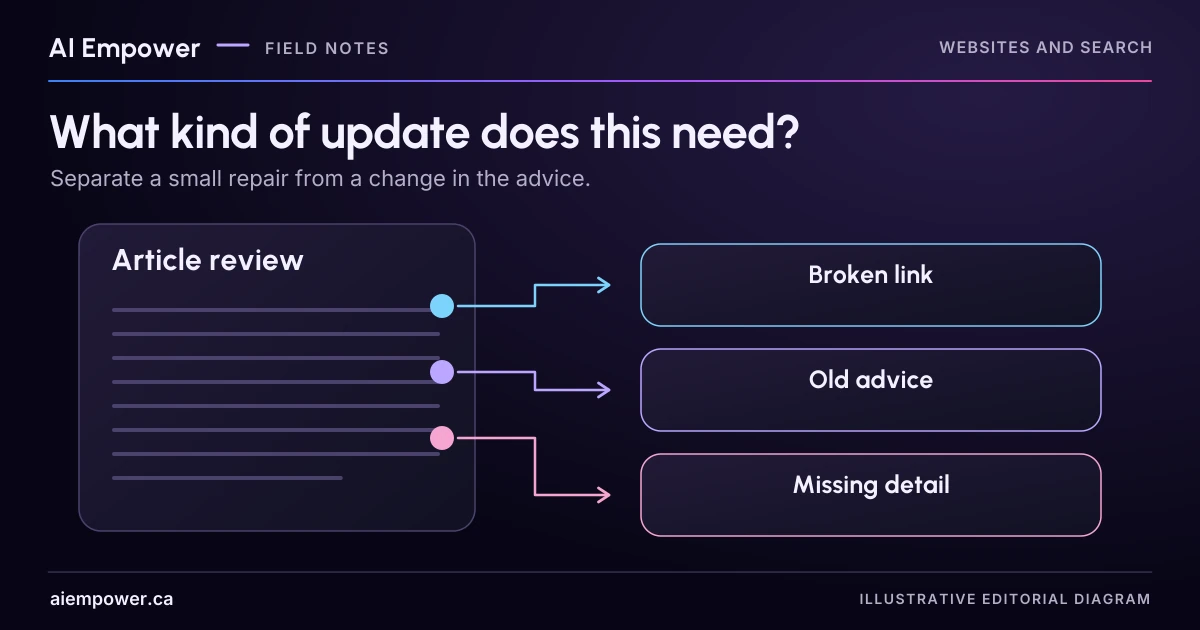
Decide whether the issue needs a link repair, clarification or material revision, then record the change and an honest date decision.
You find a broken link in an older article. Should you fix the link, rewrite the advice or retire the whole page? The link’s condition alone cannot answer that. Open the passage it supports and check whether the reader’s next decision is still sound.
An update starts with a specific defect. “Make this fresh” gives an editor little basis for deciding what to preserve. A useful brief names the problem, its effect on the reader and the evidence needed for a repair.
Try the diagnostic below on one article. The examples are fictional, and the decisions are editorial recommendations rather than automatic publishing actions.
Case one: the source moved but the advice still holds
An article explains how to prepare approved service information for a website. Its citation now points to a missing page. The publisher has moved the same guidance to a new location, and you can verify that the relevant passage still supports the claim.
The likely scope is a source-link repair. Replace the URL, read the surrounding sentence again and record the new source location and check date. Do not quietly substitute a source that discusses a related topic but fails to support the original assertion.
If the original passage cannot be found, mark the claim unsupported until you can verify it. A similar-sounding search result is not enough. You may need to narrow the claim, remove it or explain the uncertainty, depending on its importance to the article.
Case two: the instructions now lead somewhere else
A fictional tutorial says to open a setting called “Automatic reply.” The current interface has split that feature into a notification setting and a separate sending permission. Following the old instruction could now produce the wrong behaviour.
That is a material revision. Verify the current workflow in the intended product and account context, revise the steps and screenshots, and retest the complete task. Check the title and description too: they may promise a capability the article no longer explains.
If you cannot verify the new behaviour, do not rewrite from memory. Add the unresolved item to the review brief and consider an appropriate temporary notice or removal from recommendations through the site’s editorial process. The right response depends on the consequence of the outdated advice.
Case three: the facts are right but the reader is stuck
An article tells owners to “check whether the form submission succeeded.” A reader asks where they would find that evidence. The article is not necessarily wrong; it may be incomplete at the exact point someone needs help.
A targeted addition could explain the distinction between a button click, an accepted submission record and a notification email. A small fictional example may be more useful than expanding every section. Preserve what already works and add only enough context to let the reader finish the task.
This is a meaningful improvement when it answers the gap. It is not a reason to add unrelated paragraphs merely to increase length.
Walk through the update decision
Copy the questionable passage and answer these questions in order:
- What is the observed problem? Broken destination, unsupported claim, changed behaviour, unclear instruction or missing answer?
- What decision does it affect? If a reader follows the page today, what might they misunderstand or do incorrectly?
- What evidence is available? Current primary documentation, a verified product observation or the responsible business owner?
- What is the smallest complete repair? A URL correction, a new explanation, revised steps, a changed recommendation or a larger review?
- What else depends on it? Title, description, illustration, worksheet, related article, service claim or downloadable file?
- How will the revision be checked? Name the reviewer and the exact reader task or claim they will verify.
The output should be a scoped brief, not an instruction to automatically delete or rewrite the page.
Week 37 · interactive local candidate
Scope the smallest complete editorial repair
Fictional local exercise. No live AI, business verification or external action. Use invented information only. Working state stays in page memory; reset or reload clears it. Copies and printouts are outside this page’s control.
Review pending. Review the current version after edits. Earlier conclusions are cleared after every edit.
Week 37: Scope the smallest complete editorial repair
Fictional local exercise. No live AI, business verification or external action. Use invented information only. Working state stays in page memory; reset or reload clears it. Copies and printouts are outside this page’s control.
All observations and checks below are fictional or reader-reported; none independently verified.

FIXED FICTIONAL EXERCISE CONTEXT
{
  "moved": {
    "name": "Source moved",
    "passage": "Prepare approved service information before publishing it.",
    "problem": "The cited page is missing. Its publisher may have moved the passage.",
    "decision": "Can the reader still rely on this preparation advice?",
    "dependencies": [
      "Citation",
      "Surrounding claim",
      "Downloadable checklist"
    ]
  },
  "workflow": {
    "name": "Changed product behaviour",
    "passage": "Open Automatic reply and enable it to send a reply.",
    "problem": "The fictional interface now separates notifications from sending permission.",
    "decision": "Could the reader enable the wrong behaviour?",
    "dependencies": [
      "Steps",
      "Screenshots",
      "Title and description",
      "Associated exercise"
    ]
  },
  "gap": {
    "name": "Missing reader detail",
    "passage": "Check whether the form submission succeeded.",
    "problem": "The reader does not know what counts as evidence.",
    "decision": "Can the reader distinguish a click from a stored request?",
    "dependencies": [
      "Status example",
      "Exercise answer notes",
      "Surrounding explanation"
    ]
  }
}

CURRENT INPUTS AND EXPLICIT HISTORY
{
  "caseId": "moved",
  "version": "ARTICLE-v1",
  "evidence": "unknown",
  "reference": "",
  "checkDate": "",
  "repair": "",
  "dependencies": [],
  "reviewer": "",
  "task": "",
  "note": "",
  "confirmed": false,
  "originalPassage": "Prepare approved service information before publishing it.",
  "problem": "The cited page is missing. Its publisher may have moved the passage."
}

Review pending. No current conclusion; earlier review invalidated by input changes.

LIMITATIONS AND WARNINGS
• This is editorial scoping, not automatic rewriting, deletion or publication.
• Evidence and date are fictional/reader-reported. Changed workflow needs product/account-context verification.
• No ranking improvement or full-article refresh is inferred from a link repair.
Use the text-only exercise
The complete unchanged manuscript remains readable if the controls are unavailable.
Return to Walk through the update decisionMake the date tell the truth
Keep a record of what changed and when. A visible “Updated” date should reflect a real update policy and a substantive reason the reader would care about, rather than a routine date rollover.
Google’s people-first content guidance explicitly questions changing dates to make pages appear fresh when the content has not substantially changed. It does not promise a ranking improvement for a revised date. Use dates to help readers understand the material’s history.
For a substantial revision, a short note could say: “Updated the submission-status examples and replaced the retired product instructions.” For a small link repair, keep an internal change record and follow your established public-date policy. Do not imply that every claim received a fresh review if only one URL was changed.
Keep the change reversible
Retain the previous text, current source and reason for the decision. Preserve the existing URL unless there is a separately reviewed reason to move it. A new article address creates link and redirection work that a simple correction may not need.
Before closing the update, reread the page as a visitor: can someone now perform the intended task without the repaired gap? Check the associated exercise and its answer notes as well as the prose. If the article still requires a missing source or an unverified product step, leave that item open.
Keep your website’s useful content accurate with AI Empower.
Primary sources checked 4 October 2026
Sources & review
Primary sources checked on . The checklists and planning examples are AI-assisted editorial guidance, not source quotations or reported client results.
This AI-assisted guide uses fictional examples for practice. It does not report client results or establish that a live system will behave the same way.
Originally published: .