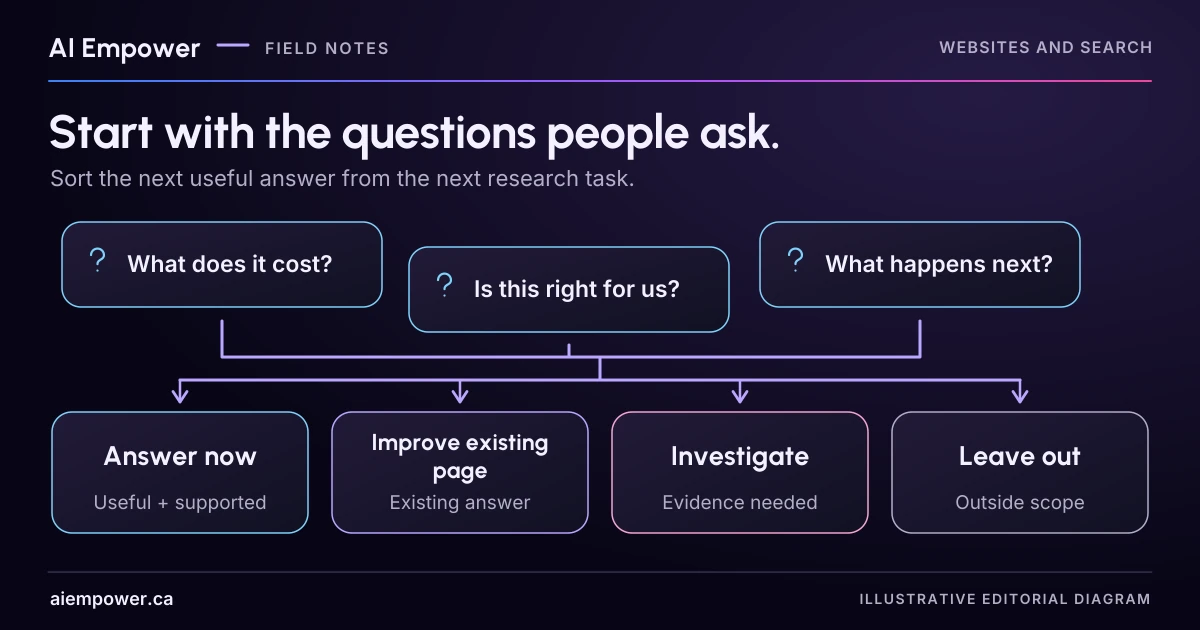
Keep question provenance and sort the backlog into answer, improve, investigate or leave out without inventing search demand.
A useful blog topic often begins with a question someone could not answer from your existing pages. Before asking AI for fifty titles, collect a few of those questions and decide which ones deserve a new article.
The task is editorial judgement: who needs the answer, what decision will it help them make, what can you support and where does the answer belong? The output is a small, reasoned shortlist. It is not a search-volume forecast or a commitment to publish every idea.
Create a question inbox with provenance
Ask staff to paraphrase questions they hear during ordinary work. Remove identifying details and private circumstances. Record the broad source, such as “course enquiries” or “service consultation,” rather than copying a conversation into an AI tool.
Give each question an evidence label. “Observed repeatedly” should have a defensible internal basis. “Asked once” is still useful evidence of one need. “Staff suggestion” and “AI-generated idea” are candidates to investigate. Do not combine them into a list labelled “our customers' top questions.”
Also record the intended reader and the decision behind the wording. “Do I need a laptop?” may mean “Can I participate in this class?” “Which software is best?” may conceal several unrelated decisions that need to be separated before drafting.
Sort a fictional backlog
Consider a fictional adult-training business, Fieldstone Learning. It offers introductory office-software classes. The following questions and observations are invented to demonstrate the method:
| Candidate question | Available evidence | Editorial destination |
|---|---|---|
| What should I check before choosing a beginner spreadsheet class? | Approved course requirements and a facilitator's review checklist | Answer now as a practical article |
| Do I need my own laptop for this course? | Current equipment policy; the course page omits it | Improve the course page |
| Can I learn everything in one weekend? | No defined meaning of “everything” or evidence of an outcome | Investigate and narrow the question |
| Which AI tool will double my salary? | No evidence; outside this provider's supported purpose | Leave out |
| How do I prepare for a beginner spreadsheet class? | Much of the answer overlaps the first candidate | Combine useful preparation guidance rather than create a near-duplicate |
“Leave out” is a valid editorial result. A title can be popular-sounding and still ask the business to make a promise it cannot support. “Improve the course page” is also productive: customers may need the answer while deciding whether to enrol, rather than in a blog they must discover separately.
Week 13 · Fictional local practice
Choose the next useful answer
A reasoned shortlist, an existing-page change and specific research questions.
Use fictional, non-sensitive values only. Entries remain in page memory. No uploads, storage or network requests are made by this activity. Copy and print occur only when selected.
Fieldstone Learning offers introductory office-software classes. Every question and evidence note here is fictional. Sort by reader decision, support and the best destination. A filled lane is a draft editorial choice, not review approval.
Your draft editorial lanes
This overview groups your choices. An item combined into another belongs in that maintained explanation; it is not an additional publication slot.
Unsorted
- What should I check before choosing a beginner spreadsheet class?
Reason: Not recorded - Do I need my own laptop for this course?
Reason: Not recorded - Can I learn everything in one weekend?
Reason: Not recorded - Which AI tool will double my salary?
Reason: Not recorded - How do I prepare for a beginner spreadsheet class?
Reason: Not recorded
Answer now
No items in this lane.
Improve existing page
No items in this lane.
Investigate
No items in this lane.
Leave out
No items in this lane.
Take your record with you
Includes all current choices, source limits and unanswered fields. Copy and print happen only when you choose.
Reader-question editorial shortlist · local practice v1
Local fictional practice only. No real business facts, outcome, legal compliance, accessibility, search performance or live account state are validated. Entries stay in page memory; no network requests, analytics or persistence. Refresh clears work. Do not enter personal or confidential information.

Fieldstone Learning (fictional). Review order is an editorial priority, not a search-volume measure.

1. What should I check before choosing a beginner spreadsheet class?
Provenance: supplied fictional exercise; evidence: Approved course requirements and a facilitator's review checklist
Lane: Unsorted
Reason / priority: Not recorded
Next action / page / research question: Not recorded
Owner role: Not recorded
Combine with: Not recorded
Reader: Not recorded; decision: Not recorded; output: Not recorded

2. Do I need my own laptop for this course?
Provenance: supplied fictional exercise; evidence: Current equipment policy; the course page omits it
Lane: Unsorted
Reason / priority: Not recorded
Next action / page / research question: Not recorded
Owner role: Not recorded
Combine with: Not recorded
Reader: Not recorded; decision: Not recorded; output: Not recorded

3. Can I learn everything in one weekend?
Provenance: supplied fictional exercise; evidence: No defined meaning of “everything” or evidence of an outcome
Lane: Unsorted
Reason / priority: Not recorded
Next action / page / research question: Not recorded
Owner role: Not recorded
Combine with: Not recorded
Reader: Not recorded; decision: Not recorded; output: Not recorded

4. Which AI tool will double my salary?
Provenance: supplied fictional exercise; evidence: No evidence; outside this provider's supported purpose
Lane: Unsorted
Reason / priority: Not recorded
Next action / page / research question: Not recorded
Owner role: Not recorded
Combine with: Not recorded
Reader: Not recorded; decision: Not recorded; output: Not recorded

5. How do I prepare for a beginner spreadsheet class?
Provenance: supplied fictional exercise; evidence: Much of the answer overlaps the first candidate
Lane: Unsorted
Reason / priority: Not recorded
Next action / page / research question: Not recorded
Owner role: Not recorded
Combine with: Not recorded
Reader: Not recorded; decision: Not recorded; output: Not recorded
No content was published, scheduled or validated. Check actual existing pages and governing sources before drafting.
Use the text-only exercise
The complete unchanged manuscript remains readable if the controls are unavailable.
Return to Sort a fictional backlogUse four lanes with clear reasons
Answer now means the intended reader, useful task and evidence are sufficiently clear to draft. It does not mean the article has passed review. Name the specific output, such as a preparation checklist or a comparison of delivery formats.
Improve an existing page means the need is real but a new URL would scatter the answer. Identify the page, the missing section and the owner. Check the actual page before deciding it already answers the question; a fact buried in an unrelated paragraph may be technically present but difficult to find.
Investigate means an important fact, audience need or source is missing. Write the smallest research question that could change the decision. “Ask the course owner which preparation tasks are required” is actionable. “Research AI” is not.
Leave out means the candidate is outside the business's expertise or purpose, would duplicate a sufficient answer, or would require an unsupported promise. Retain the reason so the same weak idea does not reappear every month under a different title.
Google's people-first guidance asks whether content serves an existing or intended audience and leaves readers able to achieve their goal. Use that as a review prompt. It does not tell you how often your customers ask a question or guarantee that your chosen article will rank.
Turn one candidate into a brief
For Fieldstone's first candidate, a useful brief could read:
- Reader: an adult comparing introductory spreadsheet classes.
- Decision: whether the level, format, equipment and preparation fit their needs.
- Deliverable: a checklist with questions to ask a provider.
- Evidence: the fictional provider's approved requirements, plus clearly labelled general questions for comparison.
- Exclusions: no job guarantee, salary forecast or claim that one course suits everybody.
- Next step: inspect the provider's actual course information and ask about unresolved fit questions.
The brief gives the writer a finish line. It also gives the reviewer a way to notice drift. If the draft becomes a list of fashionable AI tools, it has left the reader's original decision.
Decide what comes first without a fake score
Discuss practical priority with the people who answer enquiries. Which unanswered question blocks a decision? Which page is currently wrong or incomplete? Which article can be supported well now? Which answer will be expensive to maintain because the facts change frequently?
You may rank the shortlist, but preserve the reason rather than inventing a numerical demand score. A rare question about a critical prerequisite can matter more than a frequently repeated question that the current page already answers clearly.
After drafting, compare the new piece with the existing content again. Link to a maintained explanation when it already does the job. Avoid publishing separate articles for slight wording variations of the same question merely to fill a calendar.
Leave with a small, usable backlog
Try the four lanes with five questions from your own business. For every “answer now” item, write the reader, decision, evidence and output. For every “investigate” item, name the missing fact and its owner. Stop when the next writing task is clear enough for someone else to pick up.
You can sort the questions with paper cards or a document. If the question-backlog activity is available on this page, assign each fictional question to a lane, record the reason and next action, then compare with the article’s editorial reasoning. Keep the evidence label and unresolved source questions attached; the activity supplies no demand, ranking or writing-quality score.
Bring a few recurring customer questions to AI Empower to turn the strongest ones into useful service content.
Sources & review
Primary sources checked on . The checklists and planning examples are AI-assisted editorial guidance, not source quotations or reported client results.
This AI-assisted guide uses fictional examples for practice. It does not report client results or establish that a live system will behave the same way.
Originally published: .